Piano Street's Classical Piano Blog

- your guide to the classical piano world.

Blog home > Posts in November, 2008

Naxos Music Library - Online Music Streaming

NAXOS Music Library (NML) is a very useful resource for music professionals, students, amateurs and collectors.

The service offers more than 26,000 CDs with over 371,000 tracks of music for online listening.
In addition to this 500 CDs are added every month. It also contains comprehensive liner notes, opera synopses, libretti, composer and artist biographies and other essential information.

The recordings in Naxos Music Library include the complete catalogues of BIS, Chandos, CPO, Hänssler, Hungaroton, Marco Polo, Naxos and selected titles of other leading independent labels, with more labels being added from time to time.


/patrick
Share/Save/Bookmark


Boxed Tribute to Retiring Brendel

Alfred Brendel: The Complete Vox, Turnabout,
and Vanguard Solo Recordings, 1958-1970

Alfred Brendel, who during his six decades of performances, mastered the works of Mozart, Beethoven, Haydn and Schubert, has now decided to explore other passions in life such as literature and painting. He will give his last concert on December 18, 2008, in Vienna. Brendel will be 77 in January 2009.

In order to pay tribute to the great Austrian, the Brilliant Classics label has released a 35 CD box with early recordings, covering the period 1958-1970.
Read more at Brilliant Classics.

Alfred Brendel on Music - Collected Essays

Known to many as an excellent writer on music (see example below), Brendel’s sharp eyes behind his glasses has not only traced the absurdities of the world but also uniquely and simultaneously added wit and humour to every insight revealed.

“To sit down and start Haydn’s last C major sonata with a tortured look is even worse than to embark on the so-called Moonlight sonata with a cheerful smile.” (from Alfred Brendel´s essay “Must Classical Music Be Entirely Serious?”)

Alfred Brendel discusses Classical and Romantic masterpieces, as well as various other musical subjects, in this collection of essays dating from the 1960’s to the present. Pianists will find the chapters on Beethoven and Schubert sonatas, in which Brendel touches on style and interpretation,
with excerpts from the scores, especially useful. There is also a truly valuable section about Schumann’s Kinderszenen. Brendel’s essays make most rewarding reading. For a start, he is a good writer. He has a keen appreciation of the virtues of musical anecdote used to make a point. Numerous other essays are accessible to non-musicians as well, and can be enjoyed simply for the author’s wit and insight.
‘Coping with Pianos’ and ‘A Case for Live Recordings,’ for example, would be of interest to any music lover.

http://www.alfredbrendel.com/books.php

Edit 15 Dec 2008:
Excerpt from an interview with Brendel published today in The Guardian


/patrick
Share/Save/Bookmark


Adam Gyorgy Plays Prokofiev’s Scherzo

Igor Stravinsky characterized Prokofiev as the greatest Russian composer of his day. Prokofiev was also an excellent pianist, and often performed his own works.
Some of his solo piano music performances were recorded for HMV in Paris in 1935, and he was also soloist with the London Symphony Orchestra in the first recording of his third piano concerto, recorded in London on the HMV label in 1932. These recordings are now available on CD on the Pearl and Naxos labels.

In this encore from a recital at the Ferenc Liszt Academy of Music in Budapest in 2005, a young Hungarian ”rising star” pianist and Steinway artist Adam Gyorgy displays his sensitive interpretation with a steady yet lively rhythmic sense of repetition, cultivated contrasts and lovely clarity of articulation.

A fine performance of this seldom heard Scherzo.


/patrick
Share/Save/Bookmark


Beethoven’s Last Piano Piece? (free sheet music + challenge)

Ludwig van Beethoven’s supposedly “last piano work” has been found by musicologist Peter McCallum, while studying the composer’s final music sketchbook at the Berlin’s state library.


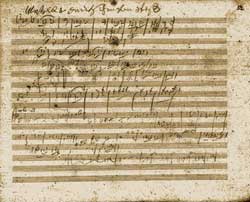
The 32 bars piece was found in the so called “Kullak sketchbook”, one of Beethoven’s working documents full of ideas, jotted notes and musical fragments. Mr McCallum noticed what he calls the “Bagatelle in F minor” in the middle of Beethoven’s sketches for the String Quartet Op. 135.
Obviously it wasn’t clear it was a piano piece instantly because Beethoven often used a chaotic sort of shorthand.
Mr McCallum said he believed the piece was written in October 1826, a few months before Beethoven’s death in March 1827.

“I didn’t know it was a piano piece until I actually sat down and tried to write it out,” says McCallum. “Beethoven almost never used clefs or key signatures so you have to think about it … but once you do crack the code it’s clear.” Mr McCallum adds.

Mr McCallum’s pianist wife Stephanie used her husband’s transcription to make the first recording of the piece—Bagatelle in F minor—which is just 54 seconds.

First recording by Australian pianist Stephanie McCallum is available online here.

Free sheet music to download and print:
Beethoven, Bagatelle in F minor - transcribed by Piano Street

A challenge…

Unlike Mozart who worked out his compositions in his mind and then wrote them straight off, Beethoven kept private notes all his working life in which each composition grew from initial idea through constant revision, bar by bar, until he achieved a final version.

One of Beethoven’s other sketchbooks, “Landsberg 5″ from 1809, including over 100 pages of sketches will soon be available as a downloadable pdf from Piano Street.
It includes sketches for one of his Piano Concertos, the Piano Sonata Op 81 and much more. Deciphering Beethoven’s rather sloppy handwriting is definitely not an easy task and by studying these sketches you will get an idea of the expertise needed for making discoveries such as McCollum’s but one first step is to take the challenge and figure out…

Which Piano Concerto theme is hiding on page 14 of the Landsberg 5 sketchbook?

Full page: Beethoven - Sketchbook “Landsberg 5″ (1809), page 14

(Beethoven’s five Piano Concertos - sheet music)

Send your answer (specify movement) to webmaster@pianostreet.com before Sunday 30 November and, if correct, you will get a free copy of the Landsberg 5 sketchbook (pdf-file) when it becomes available at Piano Street.

Special prize draw: Three people submitting the correct answer will each get one year of Piano Street Gold membership (value 36 USD).

Uptate 8 December:

The correct answer is Piano Concerto no 5, 3rd mvt and the lucky winners of Gold memberships are:

Jose Valladares
Stephan Ascher
Sakari Väkevä

Congratulations!


/nilsjohan
Share/Save/Bookmark


Smart like a Metronome?

Researchers at the medical university Karolinska Institutet and UmeĂĄ University (both in Sweden) have now demonstrated a correlation between general intelligence and the ability to tap out a simple regular rhythm.
They stress that the task subjects performed had nothing to do with any musical rhythmic sense but simply measured the capacity for rhythmic accuracy. Those who scored highest on intelligence tests also had least variation in the regular rhythm they tapped out in the experiment.

“It’s interesting as the task didn’t involve any kind of problem solving,” says Fredrik Ullén at Karolinska Institutet, who led the study with Guy Madison at Umeå University. “Irregularity of timing probably arises at a more fundamental biological level owing to a kind of noise in brain activity.”

According to Fredrik Ullén, the results suggest that the rhythmic accuracy in brain activity observable when the person just maintains a steady beat is also important to the problem-solving capacity that is measured with intelligence tests.

“We know that accuracy at millisecond level in neuronal activity is critical to information processing and learning processes,” he says.

They also demonstrated a correlation between high intelligence, a good ability to keep time, and a high volume of white matter in the parts of the brain’s frontal lobes involved in problem solving, planning and managing time.

“All in all, this suggests that a factor of what we call intelligence has a biological basis in the number of nerve fibres in the prefrontal lobe and the stability of neuronal activity that this provides,” says Fredrik Ullén.


/patrick
Share/Save/Bookmark


A Bösendorfer Grand by Porsche?

- designer collaborations link instrument making to fashion and contemporary trends.
Porsche - Bösendorfer Grand Piano

In close co-operation with the world-famous Porsche Design company, Bösendorfer has created a contemporary approach to grand piano design. Bösendofer states; In keeping with our motto — “cherish traditions, transcend limits” — this new interpretation incorporates ground-breaking new features that will have a lasting impact on the development of grand piano design. Other collaborations include Josef Frank, Chrysler and Swarovski (where each grand is adorned with 8,000 hand-cut Swarovski crystals).

Read more:
http://www.boesendorfer.com/index.php?menu=55&lang=en


/patrick
Share/Save/Bookmark


Piano Street Gold Membership - Only $5

Privacy Policy | FAQ | Contact