Piano Street's Classical Piano Blog

- your guide to the classical piano world.

Blog home > Posts tagged ‘beethoven’

Beethoven’s Last Piano Piece? (free sheet music + challenge)

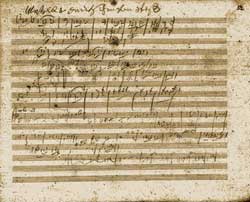
Ludwig van Beethoven’s supposedly “last piano work” has been found by musicologist Peter McCallum, while studying the composer’s final music sketchbook at the Berlin’s state library.


The 32 bars piece was found in the so called “Kullak sketchbook”, one of Beethoven’s working documents full of ideas, jotted notes and musical fragments. Mr McCallum noticed what he calls the “Bagatelle in F minor” in the middle of Beethoven’s sketches for the String Quartet Op. 135.
Obviously it wasn’t clear it was a piano piece instantly because Beethoven often used a chaotic sort of shorthand.
Mr McCallum said he believed the piece was written in October 1826, a few months before Beethoven’s death in March 1827.

“I didn’t know it was a piano piece until I actually sat down and tried to write it out,” says McCallum. “Beethoven almost never used clefs or key signatures so you have to think about it … but once you do crack the code it’s clear.” Mr McCallum adds.

Mr McCallum’s pianist wife Stephanie used her husband’s transcription to make the first recording of the piece—Bagatelle in F minor—which is just 54 seconds.

First recording by Australian pianist Stephanie McCallum is available online here.

Free sheet music to download and print:
Beethoven, Bagatelle in F minor – transcribed by Piano Street

A challenge…

Unlike Mozart who worked out his compositions in his mind and then wrote them straight off, Beethoven kept private notes all his working life in which each composition grew from initial idea through constant revision, bar by bar, until he achieved a final version.

One of Beethoven’s other sketchbooks, “Landsberg 5″ from 1809, including over 100 pages of sketches will soon be available as a downloadable pdf from Piano Street.
It includes sketches for one of his Piano Concertos, the Piano Sonata Op 81 and much more. Deciphering Beethoven’s rather sloppy handwriting is definitely not an easy task and by studying these sketches you will get an idea of the expertise needed for making discoveries such as McCollum’s but one first step is to take the challenge and figure out…

Which Piano Concerto theme is hiding on page 14 of the Landsberg 5 sketchbook?

Full page: Beethoven – Sketchbook “Landsberg 5″ (1809), page 14

(Beethoven’s five Piano Concertos – sheet music)

Send your answer (specify movement) to webmaster@pianostreet.com before Sunday 30 November and, if correct, you will get a free copy of the Landsberg 5 sketchbook (pdf-file) when it becomes available at Piano Street.

Special prize draw: Three people submitting the correct answer will each get one year of Piano Street Gold membership (value 36 USD).

Uptate 8 December:

The correct answer is Piano Concerto no 5, 3rd mvt and the lucky winners of Gold memberships are:

Jose Valladares
Stephan Ascher
Sakari Väkevä

Congratulations!


/nilsjohan


Myra Hess – Piano to Combat Evil

The National Gallery at Trafalgar Square in London is arranging a Dame Myra Hess Day on the 25th of November (2008). This annual event honours Dame Myra Hess who initiated, directed and performed a series of legendary concerts at the National Gallery during the Second World War.
This year’s concerts will take place in the Barry Rooms (Room 36), where the original concerts were also held. UK-based international pianist Piers Lane is the artistic director of the Myra Hess concerts, and the arrangement is supported by The Ernest Hecht Charitable Foundation.

During the war years and the blitz, Dame Myra Hess organized over one
thousand concerts at the National Gallery. The Gallery had removed all
the paintings, keeping just one on display each month, and thousands of
people (many not regular concertgoers) came to listen, be inspired, and
possibly garner a little hope from these wartime concerts.
The concerts were a cultural oasis for thousands of Londoners during a time when the concert halls and theatres were otherwise closed. For Myra Hess, the concerts were a wonderful opportunity to “give spiritual solace to those who are giving all to combat the evil”.

Legendary English pianist Dame Myra Hess (1890-1965) studied at the Royal Academy of Music. She made her London debut in 1907, performing Beethoven’s Piano Concerto No. 4 under Sir Thomas Beecham.
She first appeared in the United States in 1922.
Her playing was acclaimed in terms of both its virtuosity and poetic sensitivity.
Hess was most renowned for her interpretations of the works of Mozart, Beethoven and Schumann, but had a wide repertoire ranging from Domenico Scarlatti to works by contemporary composers.

In this rendition of the first movement of Beethoven´s “Appassionata” Op. 57 from 1945, her modern sense of drive and virtuosity, which never overshadows the poetic vision of drama and contrast, is clear for all to hear.


/patrick


Michelangeli Plays Beethoven Sonata Op. 2 no. 3

Arturo Benedetti Michelangeli (1920 -1995) was an Italian classical pianist. He is considered among the most commanding and individualistic piano virtuosi of the 20th century, alongside names such as Vladimir Horowitz and Sviatoslav Richter.
Along with Ferruccio Busoni, he is often described as the most important Italian pianist ever.
He obtained his soloist’s diploma at the age of fourteen, and was immediately launched into his concert career. His extraordinary talent was recognized instantly and in 1939 he won first prize in the prestigious Geneva International Competition, under a jury headed by Ignaz Paderewski. His importance as a key figure among 20th-century pianists was confirmed when Cortot said:
“Here is a new Liszt”.

Michelangeli built a reputation as much on the frequency of his cancellation of concerts as on his piano performances.
He recorded for Deutsche Grammophon between 1971 and 1989, including four Mozart and three Beethoven concerti with the Vienna Symphony Orchestra under Carlo Maria Giulini. The Beethoven recordings are from live television broadcasts.

Michelangeli’s early recordings were made for HMV in Milan from 1939 to 1942. In addition to works by Grieg, Albéniz, Granados and Mompou, some excellent Scarlatti sonatas stand out, as does his rendition of the Beethoven Piano Sonata in C major Op. 2 No. 3 .
On this video, he plays the first movement from that same work, recorded in 1970.


/patrick


Pollini: Beethoven Piano Concerto No.5 Mvt II

If you need reference recordings of the Beethoven piano concerti, do not neglect the Pollini/Böhm collaboration from the 1980’s. Their ”Emperor” recording on Deutsche Grammophone from 1984 was internationally recognized and Pollini was described as the definition of the modern pianist.

With Pollini before our eyes, we therefore present the second movement from Beethoven´s ”Emperor” concerto no. 5 under Claudio Abbado, recorded in 1967, seven years after Pollini´s sensational 1960 victory at the Warszaw Chopin Competition.

We have become used to the fact that Pollini’s tone is crystalline, his textures transparent and his tempi perfect. His hallmark is balance, and his recording of the complete Chopin Études in 1990 has become a main frame of reference.

For anyone wanting to explore these qualities, his recordings of Debussy (1994 + 1999) and his recent Grammy-winning CD of Chopin´s Nocturnes (2006) on Deutsche Grammophone are highly recommended.


/patrick


New Recordings

26 new tracks have been added:

Chopin – Preludes op 28 no 6 and 7
Clementi – Sonatinas op 36 no 2 and 3
Handel – Minuet in G HWV 450
Hummel – Rondo
Köhler – Sonatina op 300
Lemoin – op 37 no 3 and 6
Mozart – Sorrow March K453a
Mozart – Minuet in F K94
Mozart – Rondo in F K15hh
Oesten – op 155 no 2 and 4
Rachmaninoff – Prelude c#-minor op 3 no 2
Rameau – Minuet in C
Satie – Three Gymnmopedies
Schumann – Wiegenlied op 124 no 6

All recorded in Swedish Radio, Studio 3 on Steinway model D.


/nilsjohan


Privacy Policy | FAQ | Contact