Czerny - Piano Music
Carl Czerny
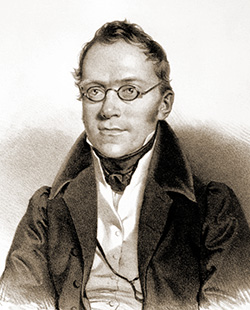
Carl Czerny (1791-1857) was born in Vienna into a Czech family, and had his first piano lessons from his father. Carl developed quickly, and by ten he was "able to play cleanly and fluently nearly everything by Mozart and Clementi" (Erinnerungen aus meinem Leben, Czerny´s autobiographical sketch from 1842). He was then introduced to Beethoven, who accepted him as his pupil. Czerny would prove very useful to his teacher over the years as an outstanding interpreter of Beethoven´s piano works. He also wrote valuable commentaries on the performance of Beethoven´s piano music.
Czerny did not undertake the life of a travelling virtuoso but chose instead to dedicate himself to teaching and composing, his most famous pupil being Franz Liszt. When Clementi was in Vienna in 1810, Czerny spent a great deal of time with him, becoming familiar with Clementi´s piano method and incorporating it into his own teaching. Czerny often taught ten hours a day, but nevertheless found time to compose more than a thousand works. He is mainly known for his many sets of studies and exercises for piano, especially the School of Velocity, Op. 299. Czerny´s complete schools and treatises combine sound pedagogy with remarkable revelations about contemporary performing practices, and present a detailed picture of the musical culture of the day. His most substantial work in this vein, the Pianoforte-Schule Op. 500, covers an extraordinary range of topics, including improvisation, transposition, score reading, concert decorum and piano maintenance.
In the 1840s Czerny´s health began to fail. His enormous productivity had earned him a respectable fortune which, on his death, he left to various charities, including (as a tribute to his teacher Beethoven?) an institute for the deaf. The predominant view of Czerny as a zealous pedagogue, producing an endless stream of dry and unimaginative works, might have its origin in Robert Schumanns many bad reviews of his music.
However, not everyone at the time shared Schumanns unfavourable opinion. Czerny was held in high regard by many, including Liszt and Chopin, and as the teacher and mentor of many important musicians he remains a central figure in the transmission of Beethoven's legacy.
Czerny Piano Sheet Music
for digital devices or to download & print
Total pieces by Czerny: 88
ID:10Forum posts about Carl Czerny
Book Recommendation on Improvising by galante
I would like to learn to properly improvise on the piano, but I can't find a physical book that will help me improve my skills. I know o...
Czerny First Instruction in Piano Playing by bachapprentice
Hi, Longtime member here but mostly a Trumpet and classical guitar player. I love piano and Bach of course. I finally want to learn piano. I...
Foundations of repertoire and technique by liszt-and-the-galops
Between Czerny, Hanon, and Bach, which do you think provides the best foundation for technique? Are there other composers who are equally as...
Needing advice for advanced piano technique by riadossie
Hello everyone, I'd like some advice on piano training. I have failed my grade 7 piano exam twice, I obviously have some serious gaps in...
A beginners question about performance by robertcross
i've been practicing piano regularly as an adult (37 years old) with a great teacher for 3 years now. My teacher and i work through repi...
Is this forum meant for players only or do people discuss piano music? by dedalus89
Preeetty much got it all in the subject. I listen to a ton of classical music and lately I've been listening to a lot of Czerny, H...
Is Czerny's double note etude Op. 245 possible? by cuberdrift
This is one of Czerny's "Grand �tudes" that no one has recorded, easily rivalling or surpassing the most difficult Alkan and L...
I need music to work on passagework by sempre_piano
It's a problem for me that I neglect most pieces with passagework. I have an irrational fear of sounding like I'm trying to showoff....
Selected Czerny Studies by Emil Liebling by permata
Hi, I have played piano for years, but my foundation is rather shaky. Currently, I am thinking of learning from the Selected Czerny Studies ...
How difficult are Czerny 636 and 299 by orbulation
I want to learn some of Czerny�s op 636 and 299. How difficult are these compared to each other and in RCM levels. I learned 636/6 and it gr...
Finger Exercises by leigh anne
Hey guys, I'm back!! With another question. The last few days I have been commenting in people's posts, giving advice and stuff but ...
New teacher. Now Czerny... by geopianoincanada
I have a new teacher now. She is turbocharged, yikes! It's going to take me a while to learn how she thinks and how she approaches piano...
classical piano pieces for a beginner? by larrys
I'm not sure what grade I would be classed as because I've never had lessons but I am making my way through Carol Barratt book one ...
Czerny Op.599 by martinn
Is there any reason to practice on Czerny Op. 599 ? I am a beginner, 50 years, and I like some things, like finger independence and tr...
What do you do when you feel you suck at the piano? by ranjit
So here's the problem, at least for me: It seems like learning a piece should be fairly simple, at least the way my teacher puts it, le...