Wolfgang Amadeus Mozart
Turkish March (Rondo Alla Turca)
in A Minor, K. 331
The "Turkish March" or "Turkish Rondo" is the last movement of the Sonata in A major, K 331. Its joyous character and fast ornamental patterns has made it one of Mozart's most popular piano pieces.
Turkish March (Rondo Alla Turca)
K. 331
Year: -
Period: Classical
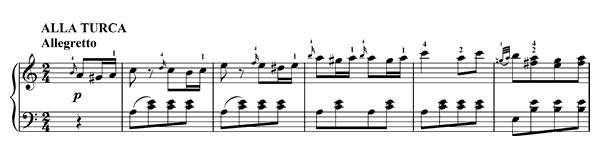
 Piano score: PS Urtext
  Audiovisual Study Tool
This piece is now avaiable in the revolutionary Audiovisual Study Tool!
See the tool in action is this short demo video of a few other pieces:Learn more and get access to the AST >>
Battle music for zurna and zil
Many would rank this as the single most effective movement in all of Mozart's piano sonatas. It has a quite unusual, complex form which is not immediately recognisable as the standard classical Rondo. Taken in very large chunks, it is constructed in an A-B-A-B-coda form, where each letter has several smaller sections inside. The A section is in the minor mode, and the B section plus coda in A major, like the two other movements of the sonata. This music is supposed to suggest an exotic military marching band, and so the character is something in between triumphant, showy and humorous. While the left hand uses pretty basic patterns of divided chords and occasional spread octaves, the right-hand engages in much delicate fingerwork, alternating with blocked and broken octaves.Background
The army music of the 17th century Ottoman Turkish Empire was something that inspired several Western composers, not only Mozart but also Haydn, Beethoven, Jean- Baptiste Lully and others. In the west, this was often called Janissary music, after the elite troups of the Sultan, the yeniçeri. Common instruments in a Janissary band were the zurna (a very loud, oboe-like double-reed), a boru (a trumpet), the nakkare (small kettledrums), the davul (a large bass drum), and the zil (cymbals); loud percussion and piercing wind instruments, designed to be heard on the battlefield.In Mozart's time, when imitating this kind of music at the keyboard, it was not unusual to make use of a so called Turkish stop, a pedal that caused a bell to ring and/or a padded hammer to strike the soundboard in imitation of a bass drum.
Illustration of Janissary music on YouTube
Practice & Performance Tips:
Don't feel forced to play this movement extremely fast, even if that is what you hear in several recordings. After all, the tempo marking is Allegretto, not Allegro or Presto. Keep a steady pulse throughout; remember that the music is supposed to suggest a marching military band!Play clearly and lightly in the sections marked piano (eighth-notes staccato), and save the heavier touch as well as the right pedal for the octave sections and the coda. The right hand chords in bars 97, 98, 103,104,116 and 117 should be... Sign up for a Gold membership to read the practice tips.
Forum posts about this piece:
What is my next piece should be ? by mohammad2002
Hi Everyone, I have recently done working on Chopin Nocturne No.20 in C# Minor, I feel like I didn't struggle much with the piece even the scales at the end of the piece wasn't that hard for...
Please help me on this question by liszt-and-the-galops
Can you rank these pieces from easiest to hardest? Fantaisie-Impromtu Moonlight Sonata (Movement 1 only) Raindrop Prelude (Chopin's, I'm expecting this to be the easiest.)
The Turkish Flavors of Mozart’s Rondo by danaunplugged
I made a six minute video that gives some information on the Turkish inspiration to Mozart’s famous piano piece, Rondo Alla Turca. It’s an informal YouTube video. At the end, I demonstrate a “Turkish...
Is 'Rondo Alla Turca' hard? by ziggy50
Hey, I have an audition coming up in two months and I have to learn two songs. So I'm learning nocturne in E flat major. I was going to learn Rondo Alla Turca also but I am not sure if I will have time to...
Octaves passage in Mozart's "Rondo alla Turca" by stormx
Hi !! I am currently learning Mozart "Rondo alla Turca" (3º movement of his K331 sonata). I have a question regarding the fingering of the "octaves passage". I have...
"My" first piece - Turkish March by Mozart by ggpianogg
Hi guys, I've started playing the piano (well, the keyboard) around 3 weeks ago, when I found my sister's old piano which she used to play with for fun at a very young age. Since I always...
Trill on mozart rondo alla turca by pbhattac
Hello, I have one question regarding this, is the trill on bar 25 supposed to start on B and go BCBCBC or is it supposed to start on C and go CBCBCB? Thanks in advance....
Tempo for Alla Turco by timothy42b
Hope I spelled that correctly! <g> What would be a reasonable tempo range for this piece? It's on my "life list." It's been fairly far down the...
mozart technique by sonata76
hi quick question.would you say ronda alla turca is good for technique?my right forth and fifth fingers are weaker than my left.any help would be...
What is the level of by barnowl
Beethoven's Marcia Alla Turca,...
Ronda Alla Turca fingering question by ca1ibanxj
Specifically, the left hand pattern from measure 21-26, and also the right hand 16th note runs in measures 36-44. What are the conventional fingerings for these, and what do YOU use? All help is...
Ronda Alla Turca - K331 or K311? by pianorama
I really do not understand this. Why, in some editions, does it list Rondo Alla Turca (Mozart, of course) as K331, while others use K311? Most say K331, but I've seen at least two editions listing it as...
Is Mozart's Rondo all turca hackneyed? by Contrapunctus
I wanted to play it at an audition till I realized it most probably is hackneyed. What about K. 545? Even at the speed gould performs it...
Rondo alla turca (Turkish March) by Mozart by beanz
Hey guys :). I am new to playing the piano (started a year ago) and i am attempting to play Turkish March by Mozart. I am having a few problems playing the grace notes (ornaments) in the beginning of measure 6...
rondo alla turca technique by lufia
im really having a hard time mastering the coda for this piece(the ending). i've fully mastered everything else except for this part and the spreading octive part needs a touch up. i find it extremely hard...
Rondo Alla Turca..... by hiscookiemonster
Ok, I'm new..... :) In about a month I am going to have a recital(nothing big...I am late intermediate). A recital for all the students my teacher teaches. From the subject you see what I'm...
Rondo Alla Turca Question by Awakening
I'm getting ready to perform this piece in a recital, so I've been listening to as many different recordings of it as I can, in order to get a sense of how I should play it. I come across the...
ez rondo alla turca?? by UrbanSpice
Just wondering if anyone knows of an ez version of Mozart's alla turca. I got a six year old who is love with anything classical and made a request to play this. (It makes me happy when little kids tell me...
Mozart Rondo alla Turca by pianoannie
I'd like ideas for teaching a particular section of Rondo alla Turca. The 3rd theme (sorry, don't have the measure numbers in front of me) reappears near the end, but this time as octave 16th notes (A A B...
Members who like this piece have also downloaded:


Alla Turca in A Minor - K. 331 is a piano piece by the classical composer Wolfgang Amadéus Mozart who lived between the years 1756 and 1791.
It is written during the Classical era and is included in Miscellaneous pieces by Mozart.