Ludwig van Beethoven
Für Elise
in A Minor
The graceful, meandering simplicity of this slightly melancholy music never loses its charm. The opening phrase is one of the best known motifs in classical music.
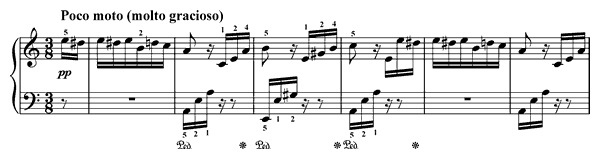
 Piano score: PS Urtext
  Audiovisual Study Tool
 Für Elise - FREE SAMPLE (mp3 file)
This piece is now avaiable in the revolutionary Audiovisual Study Tool!
See the tool in action is this short demo video of a few other pieces:Learn more and get access to the AST >>
The mysterious Elise
Für Elise (or Bagatelle in A minor WoO 59) is a rondo with two episodes - the form can be described as A-B-A-C-A. Its beautiful sequence of continuous rolled chords divided between the hands is one of the most well-known piano themes of all time. One of the things that makes this piece so hypnotic is the stubborn sixteenth note movement, continued almost throughout the piece, and only changed at a couple of very strategic places for maximum effect. There are two short passages where the speed of the notes increases: the first episode has five bars with thirty-seconds, and the second episode has five bars with sixteenth-note triplets. In connection with these passages, there are also two places where the continuous movement is stopped (bars 35-36 and 75-76). In addition, there is the very peculiar jumping E octaves towards the end of the A section. All this adds to the impression that the music is somehow trying to break free from its melancholy meanderings, but is always reined in by the recurring E-D# motif.Background
The piece was composed in Beethoven's middle period. The discoverer of the piece, Ludwig Nohl, affirmed that the original autographed manuscript, now lost, was dated 27 April 1810. However, it was not published until 1865, several decades after the composer's death, by the Beethoven scholar Ludwig Nohl.The title, meaning "To Elise", has puzzled Beethoven researchers. There is no record of any woman named Elise in Beethoven's life, and the fact that the original autograph manuscript is missing has fueled speculation. One of the most established theories, suggested by Max Unger, is that Nohl misread the dedication, and that Beethoven intended to name the piece "Für Therese". Around 1810, Beethoven was in love with a woman called Therese Malfatti, and even proposed to her, but was rejected. The other main theory is that Elise might have been a nickname for the opera singer Elisabeth Röckel, Beethoven's close friend, who later married the composer Johann Nepomuk Hummel.
Practice & Performance Tips:
Because of its great popularity, Für Elise is perhaps played and taught more than any other piano piece. For many piano beginners, its an important goal to be able to play at least the first section. And the first 22 measures are certainly playable even for someone with quite limited skills. To be able to perform the complete work, one should have acquired a more solid technique.Since the only dynamic indication of the score is pp (measures 1 and 77), it’s suitable to use a rather subdued and soft touch more or less throughout, although one is of course free to add slight crescendos and diminuendos, perhaps even approach a forte in the dramatic episode at measures 60-76 (before the return to pianissimo).
Strive to keep a consistent speed through the various sections. Make sure not to play the characteristic E-D#-E-D#-E figures mechanically; instead, shape them with great care, always adhering to the graceful flow of the 3/8 time... Sign up for a Gold membership to read the practice tips.
Forum posts about this piece:
Czerny First Instruction in Piano Playing by bachapprentice
Hi, Longtime member here but mostly a Trumpet and classical guitar player. I love piano and Bach of course. I finally want to learn piano. I was wondering if this is a good book to start off with or some...
Please help me on this question by liszt-and-the-galops
Can you rank these pieces from easiest to hardest? Fantaisie-Impromtu Moonlight Sonata (Movement 1 only) Raindrop Prelude (Chopin's, I'm expecting this to be the easiest.)
What piece do you guys suggest? by pianoguy2009
Hi, I am a pianist who just passed grade 6(with distinction)ABRSM and I’m about to start grade 8(yes, I skipped grade 7) and I’m looking for some classical pieces to practice so I can perform, however,...
Best edition of Beethoven bagatelles? by kosulin
Hi, What (preferably Urtext or Critical) edition would you consider the best? Ideally it should include all bagatelles, including both versions of Für Elise and other WoO, if such edition exist...
ABRSM Performance by barline
Hey, I am an intermediate pianist and I am going to take the ABRSM Grade 5 soon. I am unsure whether my pieces are good. I am aiming for a merit or distinction, I have chosen Bagatellen op. 119 (Beethoven),...
Hand position and pedaling, help? by lexi2k17
Hi, I am new to the forum, thought I would ask a question. I have self-taught myself piano for 14 years, and I can now comfortably play advanced pieces like Fur Elise and The Sugar Plum...
So someone approached me to teach them piano by ranjit
It was mostly as a favor. I taught them how to recognize notes, how to construct major and minor scales and chords, constructing chords based on the scale, how they are related, as well as how to read in about...
Doesn't everybody hate music and Beethoven? by j_tour
I'm just so glad [url=www.pianostreet.com/smf/index.php?topic=67288.0]this[/url] turd is allowed to exist. I hate Beethoven as well. I love that retardeds are allowed to...
5 Pieces to Play Instead of Fur Elise by fredviner
www.youtube.com/watch?v=DsfRZSaTS9s If you're looking for more obscure intermediate repertoire, then this is the video for you!...
Next Piece by cjb368
Hello, I will be starting my 4th year of piano studies in 2021. I am self taught, except for 5 lessons my wife gave me as a gift. The lessons were good,the teacher helped me with some problems(lack of...
"Fur Elise" by Beethoven. Common mistakes to avoid. by vladimirdounin
I did not find on You Tube a single pianist, who played in “Fur Elise” the music written by the composer. Everyone I've heard substituted Beethoven's great music with his/her own...
Fur Elise last measure by renie
I have 2 Alfred piano method books with Fur Elise. An older book shows the RH in the last measure playing one 8th note A. The Alfred mastering the Piano shows RH playing Middle C and A together (6th...
How long to play fur elise full version at a satisfactory level by thomas82
Hi, I have started learning this piece fur elise for a few weeks. Able to tackle section A comfortably but section B and C i have a hard time to play at a reasonable tempo. May i know how...
Easy coordination pieces for older beginners by shine11
Hello I have a lot of older beginners starting up recently. By "older" I mean 50+. As all us teachers know, the coordination side of playing is much more difficult at this age...
What to learn... by jodecahedron
Hiya! This is my first post... but I'm glad I found this site so expect to see me a lot :) I'm a student studying grade 5 who started a year ago when I was around 12. I really should...
Your thoughts on my teacher & help by pianist7s
So, this will be my 3rd Piano Teacher and I been watching his piano videos for weeks. I like his piano playing. I think he be great teacher for me, unlike my other two teachers they wasn't great teach for...
What piece should I learn next? by ranjit
So, I have been learning piano (on a keyboard) on my own since about a year. I can play Fur Elise and Chopin Nocturne Op 9 no. 2. However, I only have a touch-sensitive 61-key Yamaha PSR E343. (I slightly...
What piece should I learn next? by johnnypresto
I started playing a year ago and I'm not seeing a teacher (though I plan to start soon), but so far I've managed to learn pieces like For Elise, Canon in D, Bach's Prelude in C and Chopin's...
The Polonaise by Bach by 1piano4joe
Hi all, I read in several different sources that the Polonaise is ALWAYS accented on the 3rd beat. There are 3 Bach Polonaises which strangely are all in the key of G minor. BWV 119, BWV...
Help please by woodenfarts
Hello nice people , My mom started teaching me piano when i was 6 , I kept playing till i reached grade 7 and stopped because i was lazy and my mom gave up hope on me because i didnt want to , but she always...
Advice on Recital Piece by mariesan
Hello! I need advice for a recital piece this coming December. I don't know my piano grade but I've played piano for almost 4 years now, and I have already played these pieces for previous...
Students who want to play advanced pieces and avoid step-by-step learning by dagny_taggart
I have students who are interested in playing Fur Elise, The Entertainer and other popular classical pieces within the first year of learning and they will attempt it on their own (which I do not discourage),...
Members who like this piece have also downloaded:


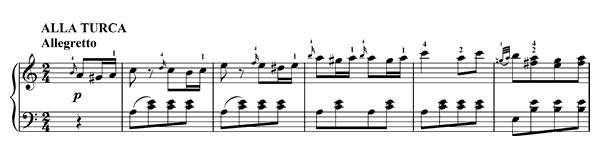


This piece is composed by Ludwig van Beethoven and was published in 1810. Title: Für Elise, in A Minor . The difficulty level if graded by ABRSM would be approximately 5 and it belongs to the Classical period.