Piano Street Sheet Music
Welcome Guest!
Please login
or sign-up.


Looking for Bartók piano sheet music? View all pieces >>

Bartók - Piano Music

Béla Bartók (1881-1945) was born in the small provincial town of Nagyszentmiklós, then Hungary (now Sânnicolau Mare in Romania). He received his first piano lessons from his mother, and showed great talent already at four years of age. He later studied piano and composition at the Budapest Royal Academy of Music. In 1902 he met Richard Strauss at the Budapest premiere of Also sprach Zarathustra, and about one year later Bartók´s own grandiose and nationalistic tone poem Kossuth was premiered. By this time, Bartók was also a renowned piano virtuoso, travelling abroad performing music of Liszt and other romantic composers. But when he became professor of piano at the Budapest Royal Academy, he more or less abandoned this career and spent more time composing and collecting folk songs from different parts of the world. Together with fellow composer Zoltan Kodály, he had systematically been collecting and recording Hungarian folk music, and now he went on to visit Turkey and parts of North Africa. In spite of Bartók’s preoccupation with Hungarian folk music, his work was at not at all appreciated by his own people. In the rest of Europe, however, his fame was rising quickly. Apart from the influence of folk music and the romantic heritage from Liszt and Brahms,
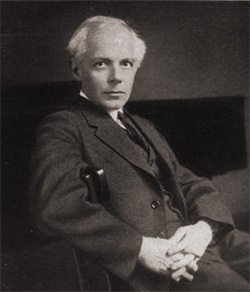
Bartók also adapted for his own purposes the methods of his contemporaries Strauss, Debussy and Stravinsky. All these elements combine to make his output extremely varied, vital and forceful, melodically and rhythmically. More than a quarter of Bartók’s output was for the piano. His educational work Mikrokosmos progresses from the very simple to the highly demanding, and explores almost all aspects of the piano’s potential.
The events of World War II forced Bartók to flee Hungary and emigrate to the USA. The fact that he was relatively unknown in this country, together with his failing health and a difficult financial situation, made Bartok´s last years unhappy. In 1945 he died of leukemia and was buried in New York. After the fall of Hungarian communism in 1988, his remains were transferred to Budapest to be given a full state funeral.


Notable works:
Opera - Bluebeard´s Castle
Ballet - The Wooden Prince
Pantomime - The Miraculous Mandarin
Orchestral - Concerto for Orchestra, two violin concertos
Chamber - six String Quartets, Contrasts for piano, violin and clarinet
Piano - Three piano concertos, Sonata, Out of doors suite, Sonata for two pianos and percussion. Educational: For Children, Mikrokosmos, Ten easy pieces


Piano Sheet music by Béla Bartók to Download

For instant access to the printable sheet music of pices by Bartók and thousands of other classical piano pieces, sign up for a Piano Street Gold Membership! sign up

Total pieces by Bartók: 11

Title Key Published Type Level
Allegro Barbaron/a 1911 Piece 8+
Suite - op 14n/a 1918 Suite 8


Romanian Folk Dances
1915 was a Romanian year for Bartók, with piano settings of Romanian Christmas Songs, the Sonatina for piano later transcribed for orchestra as Transylvanian Dances, and the Román nepi táncok (Romanian Folk Dances). These six miniatures are fairly straightforward renderings of folk tunes collected by Bartók himself. Romanians were treated as second-class citizens in the Austro-Hungarian Empire, but the richness of their folk traditions was held in high regard by in Bartók.
Stick Game no 1A Minor 1915 Piece 5
Peasant Costume no 2D Minor 1915 Piece 2
Standing Still no 3B Minor 1915 Piece 5
Song of the Mountain Horn no 4A Minor 1915 Piece 4
A Garden Gate in Romania no 5D Major 1915 Piece 5
Little One no 6D Major 1915 Piece 6


Etudes
In a letter written nearly two decades after the composition of these studies, Bartók admitted to a friend that "I cannot play the three Etudes. I haven´t played them – ever or anywhere – since 1918." They are contemporary with the pantomime The Miracoulous Mandarin, Op 19. With these two works Bartók entered his most radical, Expressionist phase (1918–22), influenced by Schoenberg. An important technical feature of all three studies is the alternating expansion and contraction of the hands.
Etude - op 18 no 1n/a 1920 Study 8+
Etude - op 18 no 2n/a 1920 Study 8+
Etude - op 18 no 3n/a 1920 Study 8+


Posts in the piano forum about Bartók:

xx Question for Bartok lovers
October 18, 2006, 10:10:04 AM by justliam

First of all, I haven't visited this forum in ages lol, so I will have to come back tonight for a couple of hours and trawl through recent stuff lol.  Secondly, How many Romanian Dances are there? I know of 6 that are often played together, are there other Opus of Romanian Dances as well? Because I'm sure there are more than those 6, I have done a search on the forum but I couldn't find anything. Thanks.

Read More... | New Comment

xx Re: Bartok
March 10, 2005, 01:45:32 AM by lostinidlewonder

I agree with the Bartok Sonatas, I have seen people jump out of their seats after a good peformance of it, although very very tough. It is played in international competitions quite often.

His Roumanian Dance (1911) with 2 movements is absolutely fantastic, still very tonal though. Better than his more popular 6 movement one in my opinion. www.prs.net has midi recordings of them both. I've played before, always with great response.

Read More... | New Comment

xx Bartok
March 10, 2005, 12:23:51 AM by fnork

I seem to have a period now when I'm exploring Bartoks music. I've only played a few of his pieces before - simple ones, like "Evening in transylvania" and "Bear dance". I just started learning the first Romanian dance, op 8a, which is a lot of fun to play. I borrowed a book with sheet music from the library, and found another piece, the left-hand study, which is a great piece of music too.

I still haven't heard too much of his music though, and I was wondering what Bartok pieces you would recommend? I'm mostly interrested in the solo-piano stuff, although I've heard some really good violin - piano pieces. All of the pieces I've played so far are quite "tuneful" and not very atonal, but from what I understand, a lot of his music is... well, harder to listen to. What do you think? I don't know very much about him really, but I'm looking forward to hear more of his music.


Also, what pianists do you recommend for his music?

Read More... | New Comment


What customers said about pianostreet.com:

"All of my students are members of Pianostreet and many of my teacher colleagues have joined as well.
It is an excellent resource for students and teachers alike and there is very rarely any need to visit another website or music store in search of sheet music."

Andrea Boltresz, piano teacher
Robertson, Australia

"As a frequent user of pianostreet.com I find it easy to navigate, great value for money and very professional. The pieces are all well-graded and the audio is really useful, especially for pieces not heard before. I have recommended the site to many of my friends who play the piano. Keep up the good work."

Paul, Llansannan, UK.

"Wonderful service! [...] I have no reservation in recommending it as a “must” to all pianists, both teachers and students, amateur and professional."
Read full review >>

Dr. Robert J Keane, pianist
Australia

"I was in Poland the past summer to give 2 concerts. At the last minute they requested some Chopin, which I had not brought with me. So, I google-searched for classical downloads and found your site. I was able to print out excellent editions of the pieces I needed within minutes. To find the scores locally would have been inpossible as it was a smaller town, the nearest music store 45 minutes away."

Robert York, pianist
Long Beach, California

"Piano Street has been a wonderful tool to me as both a pianist and a piano teacher. I can browse the collection for pieces I want to play and/or have my students play. The difficulty rating system that Piano Street uses enables me to search by difficulty level for pieces at my students' various playing levels. It is helpful that many of the scores include an audio clip of the piece being played. I have recommended to my advanced students that they also join Piano Street since getting sheet music from there is a much less expensive alternative to ordering and paying for the music.

Steve D. Allen, Ph.D.
Owner/Piano Teacher, Allen Music Studio
Houston, Texas
www.allenmusicstudio.net

Visa, Master Card, Western Union and PayPal
Official PayPal Seal


Security Verified


Privacy Policy | FAQ | Contact