Johann Sebastian Bach
Inventions
About Johann Sebastian Bach's Inventions
In the original title to these works, the composer called them “A faithful guide, whereby admirers of the harpsichord are shown a plain method of learning not only to play clean in two Parts, but likewise in further Progress to manage three obbligato Parts well and correctly, and at the same time not merely how to get good Inventions, but also how to develop the same well; but above all, to obtain a cantabile style of playing, and together with this to get a strong foretaste of composition."
Bach used them in his teaching as a first step on the way to playing more complex contrapuntal works, such as the Well-Tempered Clavier.
Both the two-part Inventions and the three-part Sinfonias are arranged in order of ascending key, each group covering fifteen major and minor keys.
| Preview | Title | Key | Year | Level |
|---|---|---|---|---|
 |
Invention 1 BWV 772 | C Major | 1723 | 5 |
 |
Invention 2 BWV 773 | C Minor | 1723 | 5 |
 |
Invention 3 BWV 774 | D Major | 1723 | 5 |
 |
Invention 4 BWV 775 | D Minor | 1723 | 5 |
 |
Invention 5 BWV 776 | E-flat Major | 1723 | 5 |
 |
Invention 6 BWV 777 | E Major | 1723 | 5 |
 |
Invention 7 BWV 778 | E Minor | 1723 | 6 |
 |
Invention 8 BWV 779 | F Major | 1723 | 6 |
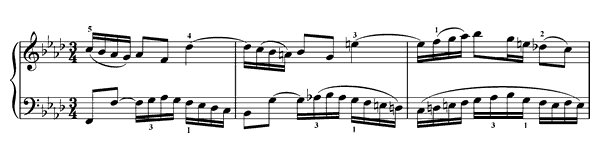 |
Invention 9 BWV 780 | F Minor | 1723 | 6 |
 |
Invention 10 BWV 781 | G Major | 1723 | 6 |
 |
Invention 11 BWV 782 | G Minor | 1723 | 6 |
 |
Invention 12 BWV 783 | A Major | 1723 | 6 |
 |
Invention 13 BWV 784 | A Minor | 1723 | 6 |
 |
Invention 14 BWV 785 | B-flat Major | 1723 | 6 |
 |
Invention 15 BWV 786 | B Minor | 1723 | 6 |
Forum posts about the Inventions by Johann Sebastian Bach
What should I play next? by advertis45
Hello y'all, I am a pre-teen, and I have been having trouble finding a new concerto/piano piece to play next. If you can, please give me...
How many hours do you practice for a one piece? (to get to recital level play) by pascalxus
I know most people will practice multiple songs and excercise per day. But, Has anyone ever logged the number of hours they practice, just...
How many Bach Inventions have you learned? by pascalxus
i'll share my Invention history: I learned Inventions 1,4,8 and 13 many many years ago. It's been so long, I basically have ...
Pieces without Teacher by rtheunissen
Dear people, For the coming 6 weeks or so my teacher is on vacation and he allowed me to learn some pieces on my own for fun during this ti...
feeling overwhelmed by contrapunctus1
So long story short, I'm currently learning the Bach Inventions with my teacher (it's me 4th week of having lessons) and I am just o...
Practicing and injury. by neeeel
I have been playing piano for a few months now, and learned a couple of Bach inventions. I want to improve my technique so I was looking at ...
Bach struggling by billybraga
Im a intermediate student, and im getting contact with the easiest Bach pieces rn (i have done pretty much of the anna magdalena bach's...
Piano tutorials on J.S. BACH Inventions no.1,4,8 and 13 by antune
Hey guys, just wanted to share my tutorials with you on Bach Inventions in C major, D minor, F major and A minor. Hope it is helpful! Cheers...
Hands Separate - how useful is it? by lettersquash
I was just looking at Bach's Two-Part Invention No.8 and wondering how much time I should spend working on it with separate hands. I�...
Progress of Classical Piano Playing by bilgekaana
What would be your road to teach a beginner player ? From day 1 to Year 5 ? and also Do you go with czerny or hannon ? When would you let...
Advanced repertoire for kid with small hands by hammerklavier
Hello community, I'm new to this board, and i hope that i post in the right section. My seven year old daughter is already playing some...
Bach Scholar - Tempos by samwitdangol
Hello! At the beginning of his Bach Invention and Sinfonia videos, BachScholar states that he has used an "innovative science method&q...
Adult beginner seeking any advice I can get by helveticat
I've been lurking here for a week or two and thought I'd see what some of you might have to say about my present predicament. I�...
Bach - Partita No. 2 In C Minor - Some Questions. by reiyza
Hi ps forum, It's been a while. I'll cut to the chase. 1. I have been playing mostly bach inventions(2 part 1,4,8,13,15, 3 part n...
Adult Students: Anyone find that the more you play the less you know? by bernadette60614
When I was a teenager I thought I played the entirety of the Moonlight Sonata fantastically. As a returning adult student, I find that two ...