Wolfgang Amadeus Mozart
Fantasia
in D Minor, K. 397
This richly expressive piece is incredibly rewarding to take on for the intermediate pianist - but its interpretation remains a considerable challenge even to the most mature and experienced musician.

 Piano score: PS Urtext
  Audiovisual Study Tool
 Fantasia K. 397 - FREE SAMPLE (mp3 file)
This piece is now avaiable in the revolutionary Audiovisual Study Tool!
See the tool in action is this short demo video of a few other pieces:Learn more and get access to the AST >>
From darkness to light
This piece gives us an insight in Mozart's improvisational style, and reveals the darker sides of his personality. The somber introduction and the aria-like melody that follows belong to Mozart’s most despairing moments. The heavy, chromatically descending octaves of measures 20-22 seems to take us to the gloomiest regions of the human soul. After sections of nervously palpitating music, and dramatic outbursts covering the entire range of the keyboard, suddenly the mode changes to D major, giving to this piece a surprisingly joyful and relaxed ending.The fantasy-character is underlined by the many silences, fermatas and mood changes. The pianist has to grasp all these different parts and make them into a convincing, coherent performance, as if reenacting Mozart's improvisation. The time signature in the D minor section is alla breve or cut time. In other words, the beat is counted in half-notes, so every bar has only two (slow) beats. The pianist that keeps this in mind will have an easier time shaping the music beautifully, especially the melody at the start of the Adagio section. There are many two-note slurs throughout the piece. Accents on the first note in these slurred pairs make them sound like expressive sighs.
Background
The Fantasy was only published after Mozart’s death, and the manuscript has been lost. In the first edition, the piece ended at the fermata in bar 97. Whether Mozart had intended to continue the Fantasy or attach it to a Sonata or Fugue remains unclear. In the Breitkopf & Härtel edition that appeared a few years later, ten concluding bars in D major, probably composed by the editor, appeared. This ending has been republished in practically every edition ever since, and are included in the vast majority of recordings of the piece.Mitsuko Uchida was probably the first recording artist to provide an alternative ending, returning to D minor and the arpeggiated chords of the beginning. Hélène Grimaud stops at the fermata and uses the Fantasy as an introduction on her recording of the D minor Concerto K. 466.
Practice & Performance Tips:
IntroductionThink of the first note of this introduction (low D) as a seed that starts to germinate and take shape. It is interesting that Mozart writes the bass line (downbeats) with long notes. This is called "finger pedal" and makes the harmonies ring more without the performer having to use too much pedal.
Practice all the arpeggios by blocking the notes to form chords. Blocking chords will help with memorization and also with shaping. Try to hear the chord progression outlined here and strive to shape this introduction that ends on the dominant chord (an important chord that prepares the listener for the theme).
Adagio
Remember that the term Adagio means “at ease”. Try to feel this section in two (remember that the time signature is 2/2, cut-time).
Mozart loved hearing and writing operas. He was definitely thinking about an aria when he wrote this beautiful melodic line. Give a singing tone to your melody while your left hand holds the bass notes (the composer is using the finger pedal technique again!). Moreover, can you play the double notes in the left hand lightly? The soft touch here will provide just the right atmosphere in the background while the right hand will... Sign up for a Gold membership to read the practice tips.
Forum posts about this piece:
How to get pieces to performance standard by orbulation
I’m going to play at a small music festival/competition, and I have my pieces about 80% ready. How do I get them to a standard worthy of a public performance(minimal technical errors etc) If it’s...
Best edition of Mozart Fantasia in d minor K.397 by m1kes_
I want to buy an Urtext edition of the Fantasia in d minor, and I'm looking at these 3 editions: Wiener Urtext Edition, Henle Verlag or Bärenreiter. I don't know which one is the best for...
Classical Repertoire Alternating fast/slow music by andy m
Hi I’m looking for classical piano pieces that alternate relatively short sections of fast and slow music for music classes. So far I’ve only found Mozart dmin Fantasia, Schumann Frightening (scenes...
Mozart: Fantasia in d minor, K 397 by contentpiano
One of the reasons I started playing the piano was because of this fantastic piece by Mozart: Fantasia in d minor, K 397. I hope you all have a wonderful Sunday, and please do enjoy my performance!
Examining a score beofre starting to play it by joe falchetto
I took piano lessons as a teenager and I was never advised to examine a score before sitting at the piano. I imagine my teacher knew both my skills and the pieces she assigned me so perhaps it was no so...
ABRSM diploma repertoire by victorkcliu
I am preparing for my ABRSM Diploma and below is my selected pieces for the recital. 1) J.S. Bach Preludes and Fugues from ‘The Well-Tempered Clavier’ BWV 859 2) Mozart Fantasy in D...
Recital Program - Little Nothings by storyseller
Hi everyone I recently came across Mozart's ballet-suite "Les Petits Riens" (little nothings quite literally) and after falling in love with it I decided to come up with a recital...
Repertoire by pianosp
Hey guys! I am new to this forum. I am just curious about the pieces that you all are currently learning. Here are the pieces that I am working on: Haydn-Sonata in C Major Hob. XVI:50
Mozart k397 Fantasy in D minor scale runs, help! by rovis77
Hi, how do you measure the scale runs, there are irregular grouping of 10 notes per beat, etc. That sounds difficult. any tips?. Or it just means that the should be played as fast as...
All Mozart Program by iumonito
Y'all are invited! I'll be playing an all-Mozart program at Highlands Presbyterian Church, 6909 Smoky Row Rd, Columbus Ohio, January 9, 2 pm. Here is the program:
Fantasy K397 interpretations and reading by adaubre
I've noticed that the passage I've posted below seems to be commonly played in a way that does not match what is written. On the manuscript excerpt I've posted, the 2nd bar in clearly...
Question about Mozart D minor fantasia. by petter
Im learning this from the sheet music available here on Pianostreet.com and I have a question about the 2nd presto part (bar 44). In the 4th note bracket with all the ascending 16th notes theres an extra...
Pedal in Mozart by elsie07
I did a search on pedaling Mozart's music, but I still have a couple questions. The piece I am currently playing and wanting to find information for is Mozart's K. 397. I learned the piece...
Members who like this piece have also downloaded:
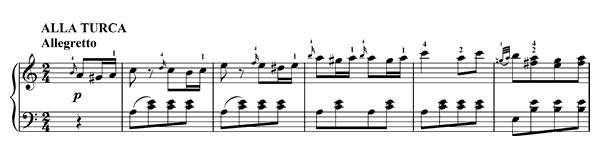
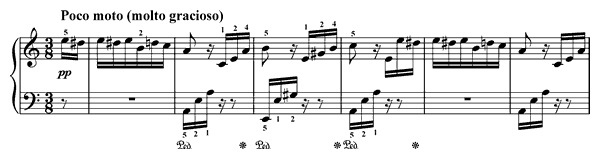


Fantasia in D Minor K. 397 by the composer Wolfgang Amadéus Mozart (1756-1791). This piece is from the Classical era and is part of Mozart's Miscellaneous pieces.