Piano Street's Classical Piano Blog

- your guide to the classical piano world.

Blog home > Posts in March, 2009

Improvisations – New Forum Section

The other day I heard Chopin improvise at George Sand’s house. It is marvelous to hear Chopin compose in this way: his inspiration is so immediate and complete that he plays without hesitation as if it could not be otherwise.
But when it comes to writing it down and recapturing the original thought in all its details, he spends days of nervous strain and almost terrible despair.”

- Karl Flitsch -

“In 1968, I ran into Steve Lacy on the street in Rome. I took out my pocket tape recorder and asked him to describe in 15 seconds the difference between composition and improvisation. He answered:

In 15 seconds, the difference between composition and improvisation is that in composition you have all the time you want to decide what you want to say in 15 seconds, while in improvisation you have 15 seconds.

His answer lasted exactly 15 seconds and is still the best formulation of the question I know.”
- Frederic Rzewski -


In the history of Western music, from the medieval until the romantic period, improvisation was an important skill for all composers and keyboard players. Bach, Handel, Mozart, Beethoven, Schubert, Chopin, Liszt, and many others were celebrated for their ability to improvise.

However, while most of the composed music easily survived in its purest form, written scores, improvised music left nothing but the traces in the minds of its listeners (or, on rare occasions written descriptions such as the above quote by Flitsch). The modern conception of the history of music is probably lacking a crucial piece of the puzzle.

Jarrett - The Köln Concert A milestone in the solo piano improvisation revival?

Jarrett - The Köln Concert
A milestone in the solo piano improvisation revival?

Consequently, in music education today and on the main concert platforms there are often distinct borders between improvising, composing, interpreting and performing, and few “classical” musicians are masters of all four trades.

Many modern jazz pianists are currently widening their musical skills and approaching the area traditionally belonging to art music. Thus, in the future, the distinction between being a “jazz pianist” and a “classical pianist” might be blurrier than it has been, not least since there also seems to be a growing interest in improvisation among classical pianists and piano teachers.

Improvisations in Audition Room

In the Piano Street forum community there is a subset of pianists exploring solo piano improvisation. In an effort to support both them and the historical tradition of keyboard improvisation we have now opened a separate section for improvisations in our Audition Room. Here you can listen to uploaded improvisations, discuss them and, not least, share your own recorded improvisations!

In order to make life easier for you when you listen to these improvisations and to all the other pieces in our Audition Room, we have now added an embedded mp3-player next to all the attached files. Just click the little play button and enjoy!


/nilsjohan


What is Left to the Right?

The list of famous left-handed pianists is a who’s who, from 20th-century legends Vladimir Horowitz, Arthur Rubinstein and Glenn Gould to today’s keyboard masters Daniel Barenboim, Radu Lupu, Leif Ove Andsnes, Steven Blier, Richard Goode, Helene Grimaud 
 and many more.

Pianist Russell Young, director of Kennesaw State University’s opera and music theater program, believes being left-handed is an advantage for pianists.
‘You read music from the bottom up on the printed page,’ he says. ‘Once you have the bassline down you get a more solid idea of the foundation and chord patterns, since the top lines [for right hand] are often more free-form melody.’
Young also suspects that lefties have a learning advantage.
All piano students must overcome the two hands’ resistance to work separately; by having to work harder on what’s essentially a right-handed instrument, the neurons of left-handed pianists get an extra workout and thus grow stronger.” Samuel Wang, professor of neuroscience at Princeton University adds, “Pianists must coordinate the activity of both [brain] hemispheres, since each hemisphere is responsible for a separate hand.”

Read more at ajc.com


/patrick


Prokofiev: Sarcasms and Visions Fugitives

“In every fugitive vision I see worlds,
full of the changing play of rainbow hues…”

Konstantin Balmont

Sergey Prokofiev (1891-1953)

Visions Fugitives (fleeting visions) by Sergey Prokofiev is a set of pieces based on a poem written by Russian poet Konstantin Balmont. They were composed between 1915 and 1917 and premiered by Prokofiev on April 15, 1918 in Petrograd, Soviet Union.

The pieces, though far from atonal, contain dissonant harmonies similar in nature of music composed by Prokofiev’s contemporaries (Schoenberg and Scriabin), although still retaining highly original concepts in both tonality and rhythm.

Read more at Classical Archives

In 2007 the modern Jazz ensemble “Quartetski Does Prokofiev” released a CD which in a unique way captures the spontaneous spirit of these pieces. Listen to some free samples here!

Sergey Prokofiev -  Sarcasm, opus 17 no 4

Sarcasm, opus 17 no 4

The five Sarcasms (opus 17) are percussive pieces with considerable rhythmic motion.  They storm, rage and thunder throughout.

The Visions Fugitives, Sarcasms and Prokofiev’s own piano transcriptions of the March and Scherzo from his opera “The Love for Three Oranges” opus 33 have now been added to Piano Street’s sheet music library.


/henrik


Heller: Songs without Words

The Hungarian-French composer Stephen Heller (1814-1888) produced a large amount of piano music of which his numerous studies are still very popular because of their fine pedagogical qualities as well as their strong and appealing characteristics. His other piano pieces of all kinds, variations, character pieces, operatic transcriptions, fantasies, sonatas, dance movements, nocturnes, waltzes, caprices and scherzos might by today’s standards be considered slightly old-fashioned and have difficulties asserting it’s place on the concert stage among more popular composers such as Chopin, Schumann and Brahms.

Stephen Heller - Songs without Words:
Gentle Reproach, opus 138 no 2


The title “Album for the Young” has been used by many other composers and the most known among today’s piano students are of course the fine collections of pieces by Schumann and Tchaikovsky. 
Heller’s Album for the Young, opus 138 is a collection of 25 pedagogical pieces of which the first five, entitled “Songs without Words”, have been added to Piano Street’s library of sheet music and recordings.

New sheet music and recordings:
Heller – Album for the Young, opus 138 no 1-5 (Songs without Words)


/nilsjohan


Piano Playing – A Public Health Concept?

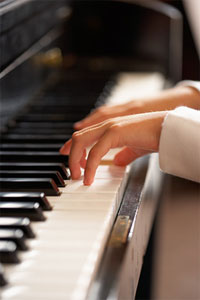
Pianists who begin practicing in childhood have been found to have better developed nerve pathways in parts of their brains. Scientists believe this results in better fine motor coordination.

When children practice the piano, their brains develop.

Most professional pianists begin their careers in early childhood. Very few people can develop their capacities as fully later in life. A research group under the leadership of  Fredrik Ullén, a neuroscientists at the Karolinska Institute (Stockholm, Sweden) and an internationally renowned concert pianist, has made a discovery that may help explain why this is so. Their findings are presented in the journal Nature Neuroscience.

Using diffusion tensor imaging, the research team investigated effects of piano practicing in childhood, adolescence and adulthood on white matter and found positive correlations between practicing and fiber tract organization in different regions for each age period. For childhood, practicing correlations were extensive and included the pyramidal tract, which was more structured in pianists than in non-musicians. Long-term training within critical developmental periods may thus induce regionally specific plasticity in myelinating tracts.

A clear different was visible when the brains of professional pianists were compared with those of non-musicians, particularly in the “pyramidal pathway,” that governs the work of the fingers at the keyboard.

“Our main finding is a clear effect that can be attributed to practice in early childhood,” says Fredrik UllĂ©n.

The pyramidal pathway can be described as a collection of nerve tracts that travel from the cerebral cortex through the pyramid of the medulla oblongata in the brainstem to the spinal cord. It is a part of the brain that develops most during childhood.

“The pyramidal pathway is known to be decisive to sophisticated finger movements,” Fredrik UllĂ©n continues.

His research group found that the white brain matter in the pyramidal pathway becomes well-organized from practicing the piano. White brain matter contains both the nerve fibers myelin, a lipid-containing substance that contributes to the layer of insulation that surrounds a nerve.

Fredrik Ullén believes that development of myelin is stimulated when children practice the piano. This extra insulation enables the impulses to travel faster from the brain down to the fingers.

The researchers also found that the white matter was better developed in the transitions between the areas of the brain that govern hearing and motor control.

Fredrik UllĂ©n states: “This probably affects the coordination between what we hear and what we do.”

This latter increase was not found to be as closely correlated with childhood practicing, probably because these pathways continue to develop in adulthood.

“Generally,” says Fredrik UllĂ©n, “we can state that the effect of every hour of practicing on white brain matter greater earlier in life.”

Ullén hopes to continue by studying a group of pianists who practiced as children but then stopped playing. His objective is to investigate whether the effects on the pyramidal pathways are lifelong effects, or whether they require perseverant lifelong practicing to be maintained.


PIANIST FREDRIK ULLÉN

Swedish pianist Fredrik UllĂ©n was educated at the Royal College of Music in Stockholm, but cites Finnish pianist Liisa Pohjola as being his primary influence. UllĂ©n is a highly skilled virtuoso who specializes in Sorabji, the Stockhausen KlavierstĂŒcke, the Ligeti etudes, and other works requiring a high degree of transcendental skill. He also works extensively with living composers such as György KurtĂĄg, Mauricio Kagel, George Flynn and BarnabĂĄs Dukay. He has recorded for Pro Piano and Caprice labels, but since 1996 has primarily recorded for Swedish label BIS. UllĂ©n’s large and constantly growing repertoire includes many of the most complex and demanding works in the piano literature, such as Ligeti’s complete piano Ă©tudes, Reger’s Spezial-studien and music by Sorabji. He has a particular interest in creative programming with couplings of new and traditional literature. His solo CDs for BIS Records have without exception been enthusiastically praised by internationally renowned critics and have received an impressive number of prestigious awards and accolades, including the Diapason d’or, CHOC de Le Monde de la Musique, Stern des Monats (FonoForum), RecommandĂ© (RĂ©pertoire), and Recomendado (CD Compact). UllĂ©n has performed at a large number of international music festivals, to outstanding critical acclaim (‘an unbelievable pianistic presence’, Schleswig-Holsteinische Landeszeitung, 2001; ‘spectacular’, New YorkTimes, 2001; ‘astonishing precision, stamina, and imagination’, Boston Globe, 2002).

Recordings on BIS

www.fredrikullen.com


/patrick


Diabelli – Melodious Exercises for Four Hands

Playing piano pieces for four hands is often very motivating for beginning piano students. Diabelli’s 28 Melodious Exercises opus 149 are simple but appealing pieces and the primo part stays in the five finger position all the time which makes them great for practicing sight reading.

Antonio Diabelli - Melodious Exercise, opus 149 no 3

Antonio Diabelli - Melodious Exercise, opus 149 no 3

Diabelli’s 28 Melodious Exercise, opus 149 are now available for download from the Piano Street sheet music library.


/henrik


Privacy Policy | FAQ | Contact