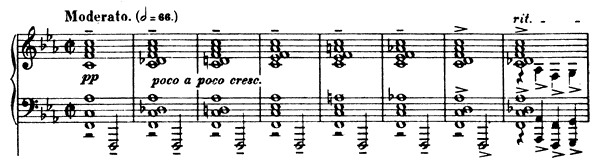
Liszt: Mazeppa
High Quality Piano Sheet Music
to Download and Print!
| ID:739
 |
| Key: D Minor |
Published: 1840 |
| Level: 8+ |
Period: Early Romantic |
Mazeppa (sheet music) |
 | Get unlimited access to the downloadable sheet music of Mazeppa by Franz Liszt and most of the other pieces in the classical piano repertoire. Sign-up for your Piano Street Gold Membership today! |
|
|
Liszt Mazeppa January 08, 2009, 08:44:42 PM by rachmanny
|
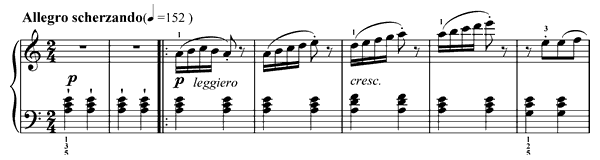
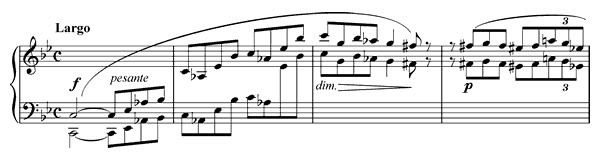
hello, i started working on liszt´s mazeppa 2 days ago and realized this will be a monumental challenge to overcome. Looking at the introduction of the piece i was wondering whether or not i needed to use pedal to make the broken chords sound correct, the piece doesn' t specify pedal in that part but i think it would sound much better with a just little.
The main theme after the intro is very hard. Im memorizing the octaves first then ill get to memorizing those quick thirds in a slow pace. Although i do have a doubt about the sets of thirds, so the fingering is much:
(left hand)4 4 (right hand)2 2 (left hand)4 4 2 2 4 4 2 2
i think thats what the score says ( M.S, M.D=left hand, right hand respectively?), is there another fingering for this? or am i interpreting the fingering wrong?...
This piece will require lots of accuracy once i get the octaves and thirds together and memorized, i just hope to practice them slowly and have little patience while attempting this.
Anyone with experience on this work please talk to me more about the approach i should take towards performing, i appreciate any advice.
Rachmanny
|
| Read More... | New Comment
|
|
Fingering for Liszt's Mazeppa June 05, 2008, 09:08:04 PM by russda_man
|
I've just started learning Mazeppa. My question is this. In the Henle edition, on the 2nd page (where the main theme begins), it indicates to play the first two (double) semiquavers with the second and forth fingers on each, and then the same thing for the right hand etc. (if you know the piece, you will hopefully know what I mean!), is this the conventional fingering which most pianists use? I just thought it might be easier to change fingers, e.g. left hand: 2 and 4, to 3 and 5. Obviously this makes a different sound, so I don't think it fits with the spirit of the passagework. Any comments would be appreciated, as I am also quite new to Liszt! Thanks Russ.
|
| Read More... | New Comment
|
|
Liszt Mazeppa December 01, 2007, 12:05:33 AM by ahkow
|
Anyone knows how to play the double third semiquavers in the middle stave, where Liszt gave the notorious fingering of 4-2? My teacher asks me to do 4-2 3-1 (For each set). Much as I agree that it's faster and gives an easier jump back to the base, it sounds very murky and uneven. I think Liszt's fingering, though it hinders speed makes the semiquavers naturally even and gives more force. It is also easier to do dynamics with his fingering (As the semiquavers are ascending, we may do a crescendo). Maybe Liszt wasn't thinking of speed when he gave that fingering. Perhaps he was thinking of musicality?
|
| Read More... | New Comment
|
|
|
Please click icons below to bookmark:
"Mazeppa in D Minor by Franz Liszt"
| What customers said about pianostreet.com: |
"All of my students are members of Pianostreet and many of my teacher colleagues have joined as well.
It is an excellent resource for students and teachers alike and there is very rarely any need to visit another website or music store in search of sheet music."
Andrea Boltresz, piano teacher
Robertson, Australia |
"As a frequent user of pianostreet.com I find it easy to navigate, great value for money and very professional. The pieces are all well-graded and the audio is really useful, especially for pieces not heard before. I have recommended the site to many of my friends who play the piano. Keep up the good work."
Paul, Llansannan, UK. |
"I was in Poland the past summer to give 2 concerts. At the last minute they requested some Chopin, which I had not brought with me. So, I google-searched for classical downloads and found your site. I was able to print out excellent editions of the pieces I needed within minutes. To find the scores locally would have been inpossible as it was a smaller town, the nearest music store 45 minutes away."
Robert York, pianist
Long Beach, California |
"Piano Street has been a wonderful tool to me as both a pianist and a piano teacher. I can browse the collection for pieces I want to play and/or have my students play. The difficulty rating system that Piano Street uses enables me to search by difficulty level for pieces at my students' various playing levels. It is helpful that many of the scores include an audio clip of the piece being played. I have recommended to my advanced students that they also join Piano Street since getting sheet music from there is a much less expensive alternative to ordering and paying for the music.
Steve D. Allen, Ph.D.
Owner/Piano Teacher, Allen Music Studio
Houston, Texas
www.allenmusicstudio.net |
|
|