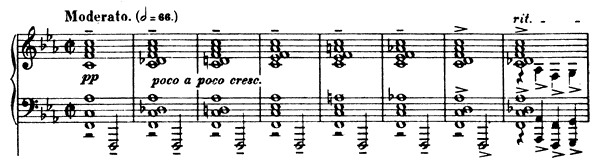
Beethoven: Sonata 12
High Quality Piano Sheet Music
to Download and Print!
| ID:24
 | How about instant access to the printable sheet music of Sonata 12 by Beethoven and over two thousand other classical piano pieces? That is what you will get as a Gold Member of Piano Street. |
|
|
Beethoven Sonata No. 12 Op. 26 March 23, 2009, 01:33:26 AM by iroveashe
|
This is a rather vague, and rather improvised explanation on Beethoven's Sonata No. 12 in A-flat major, Op. 26, 1st Movement, Andante con variazioni. This is mainly directed at Javacisnotrecognized since he asked, but I'd appreciate anyone's input into the subject.
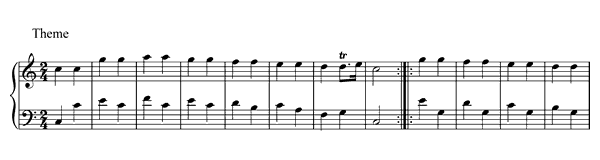
The first part establishes the main theme, and is followed as usual by variations. The theme is rather soft and light, and after being presented it is repeated with a slight variation, which gives it a sense of progression, which is, I think, a key concept to this particular movement (and many of Beethoven's works) as a way to reach climax. The first variation is mainly composed of ascending arpeggios, which rest on a high note before releasing the tension on a lower note, after doing that twice that high note is repeated instead of being released right away. Second variation is much more vivid in contrast with the 1st one and in my opinion more 'attractive'. Contrasting again is the 3rd variation, which is quite dark and mysterious. Fourth variation is more sporadic, with different parts broken down, melody on one side, bass on the other and some seemingly random chords here and there, giving it a sense of instability and spontaneity. Here, on the lasts variations is where the magic of this movement occurs; it is, again, contrasting with the previous variation. For starters it's evenly covered with notes, like a surface, always following the structure of the first main theme very harmonically but it's just that for now, the melody is not entirely distinguishable, then we start hearing the melody with a different approach, very clear and cantabile, with arpeggios as background to achieve that sense of progression, evolution and climax I first mentioned. That variation was the climax of the movement, had the variations be placed differently we wouldn't get to this part with the same feeling, and as we enter the last variation we can clearly hear from the very first bar of it that Beethoven is saying goodbye and closing the movement. That transition between the 2 last variations always leaves breathless.
|
| Read More... | New Comment
|
|
|
|
Please click icons below to bookmark:
"Sonata 12 opus 26 in A-flat Major by Ludwig van Beethoven"
| What customers said about pianostreet.com: |
"All of my students are members of Pianostreet and many of my teacher colleagues have joined as well.
It is an excellent resource for students and teachers alike and there is very rarely any need to visit another website or music store in search of sheet music."
Andrea Boltresz, piano teacher
Robertson, Australia |
"As a frequent user of pianostreet.com I find it easy to navigate, great value for money and very professional. The pieces are all well-graded and the audio is really useful, especially for pieces not heard before. I have recommended the site to many of my friends who play the piano. Keep up the good work."
Paul, Llansannan, UK. |
"Wonderful service! [...] I have no reservation in recommending it as a “must” to all pianists, both teachers
and students, amateur and professional."
Read full review >>
Dr. Robert J Keane, pianist
Australia
|
"I was in Poland the past summer to give 2 concerts. At the last minute they requested some Chopin, which I had not brought with me. So, I google-searched for classical downloads and found your site. I was able to print out excellent editions of the pieces I needed within minutes. To find the scores locally would have been inpossible as it was a smaller town, the nearest music store 45 minutes away."
Robert York, pianist
Long Beach, California |
"Piano Street has been a wonderful tool to me as both a pianist and a piano teacher. I can browse the collection for pieces I want to play and/or have my students play. The difficulty rating system that Piano Street uses enables me to search by difficulty level for pieces at my students' various playing levels. It is helpful that many of the scores include an audio clip of the piece being played. I have recommended to my advanced students that they also join Piano Street since getting sheet music from there is a much less expensive alternative to ordering and paying for the music.
Steve D. Allen, Ph.D.
Owner/Piano Teacher, Allen Music Studio
Houston, Texas
www.allenmusicstudio.net |
|
|