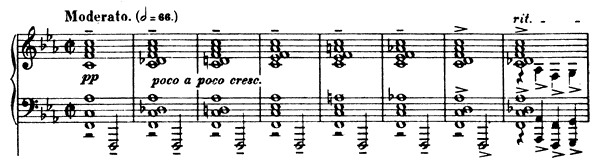
Beethoven: Sonata 14 (Moonlight)
High Quality Piano Sheet Music
to Download and Print!
| ID:26
 | Get instant access to the printable sheet music of Sonata 14 (Moonlight) by Beethoven and thousands of other classical piano pieces. Sign up for a Piano Street Gold Membership! |
|
|
|
|
General consensus on Moonlight Sonata & Fur Elise and other questions May 13, 2009, 09:01:35 AM by nosrepemos
|
Hey all, first post here, woo, whatever .
So I have finally decided, after a ~5-6 year break from piano lessons, that I want to return to the great artform that is piano music.
I have restarted my lessons a couple of weeks ago with the same teacher as before, and with a schedule of meeting every Thursday for 30 minutes. When asked about what she thought my grade level was after playing some old pieces from my old lesson books, she said 'intermediate', whatever that means.
All I know is I can play Franz Schubert's The Unfinished Symphony and his Serenade with relative ease, only having problems with getting the timing right on the triplets for Serenade. Both of these are in the book Piano Pieces for ChildrenThose are the only two assignments I got so far, having started so recently.
Righty then, enough about me, and on to the main subject! I am currently learning the first movement of the Moonlight Sonata, and actually have been for the last few weeks. It's a very moving piece, and right now I am working on bringing out the emotions in the music, and getting it smooth in general.
Now, my questions about the sonata are: 1. Is it generally look down upon intermediate players who only learn the first movement of the sonata and give nary a wink to the second and third movements? I surely want to learn the last movement, and the second movement 'seems' easy, but I know both are out of my grasp compared to the relative ease of the first movement. And I know that when you learn a sonata, you're supposed to learn all the movements in them, but I think the only movement I can learn & play here without absolutely butchering it is the first movement. Just wondering about your opinions on this issue. 2. What do you think the tempo of the first movement should be? I personally defy the alla breve notation and prefer to take the Adagio Sostenuto tempo marking very literally, playing it slow and drawn out, because I think it accentuates the melancholic feeling of the piece very nicely. However, I want to know if you guys think I'm doin' it wrong, or if the 'it's your own interpretation' excuse will work here. 3. Finally, my teacher said that recitals will be during the last week of either October or November. I am confident I can get my technical ability up by then, and I want to make the Moonlight Sonata First Movement my recital piece. I am wondering if this is a good idea? Would a returning intermediate player be able to express all of the feeling of this piece during a recital? Or should I choose something else as a recital piece?
On to the next subject, Fur Elise. Yes, that quintessential piece that everyone and their grandmother/father/uncle/brother/cousin can play. Even I remember playing it for a recital during my earlier years, although that was a fairly simplified version of only the first 'section' of the piece (the one with all the arpeggios, if you know what I mean.)
Now I want to learn the whole piece properly, but I am having doubts about it: 1. Would it be advisable to skip on this piece for now due to its immense popularity? I don't want to be 'yet another person who can play Fur Elise, yet poorly.' 2. If I were to learn it, how hard are the other 'sections' after the first one like? I'd imagine they'd be harder in comparison to the part with the arpeggios, but how much harder?
Finally, other questions: 1. Could you recommend any good books for an intermediate returning player? Right now, I have Piano Pieces for Children, The Virtuoso Pianist in 60 Exercises, Developing Artist Piano Literature Book 3 by Faber, and some Scales & Arpeggios exercise book which I forget the name of. 2. What are some nice pieces for an intermediate student to practice? Keyword here being 'nice', obviously you'll get really bored if you practice really boring pieces, so I'm mainly looking for pieces with some emotion in them, similar to the Moonlight Sonata. 3. And are there any good sites with free downloadable sheet music? I know, sure I could simply pay the minuscule 5 dollars a month here, but being a jobless and credit-card-less 16 year old doesn't help my case.
Thanks in advance, and thanks for tolerating my TL;DRness!
|
| Read More... | New Comment
|
|
|
Moonlight Sonata February 16, 2009, 08:20:08 PM by threepwood
|
Hello all piano players
I have a question I must have answered, how is the Moonlight Sonata ranked at Level 8+ ? Its one of the easiest pieces of classical music...?
|
| Read More... | New Comment
|
|
Beethoven Moonlight Sonata 1st movement February 12, 2009, 05:16:11 AM by marsippius
|
Recorded using a so called Netbook, with an external microphone. Piano is a Cumberland upright, from about 1931, tuned recently.
This is the first movement of Beethoven's Moonlight Sonata.
Everyone please enjoy, and comments welcome. The performance is still under development. This particular recording is passing my own smell test.
m
|
| Read More... | New Comment
|
|
Chopin and Beethoven - good companions in concert? December 23, 2008, 05:48:12 AM by bachobev
|
Hi guys, i just want your opinion on this. There's a talent show coming up and I'd like to play 2 pieces for a total length of about 10 min.
Do you think Chopin Etude 10 no 1 and Beethoven Moonlight's 3rd movement would go well together ? one thing that bugs me is that they are both very fast. Perhaps having a "relaxed" tempo piece with either of these two is more convenient?
Cheers
|
| Read More... | New Comment
|
|
F-sharp double sharp in Moonlight Sonata measure 188 December 18, 2008, 04:49:29 PM by marsippius
|
Hi Everybody OK, I been studying the first note of measure 188 of Beethoven's Moonlight Sonata, third movement.
The note in question is in the position of F below the base. It is sharped in the key signature, and is accidentalized with a double-sharp marking.
I listened to two examples of this note being played. In each case, the note in measure 188 sounds different from the bottom-line G in measure 189. The two performers were William Kempf and Daniel Barenboim, as found online.
What is the correct note to be played in measure 188? a. __ G -- the white note between the first and second black notes in the group of three black notes; or, b. __ G-sharp -- the second black note in the group of three black notes. c. __ It depends. d. __ Some other answer (specify).
Thanks! m
|
| Read More... | New Comment
|
|
finished moonlight sonata, what next? December 10, 2008, 09:06:24 PM by bradengineer
|
hi I'm just looking for some suggestions on what i should learn next. I just taught myself the first movement of Moonlight Sonata, I'm a beginner. It's the third song that i've actually learned. Over the past year I've taught myself to read music and play piano. I start college in the upcoming spring semester for music/piano so any advice as to what would be good to have under my belt would be appreciated.
|
| Read More... | New Comment
|
|
|
Please click icons below to bookmark:
"Sonata 14 (Moonlight) opus 27 no 2 in C-sharp Minor by Ludwig van Beethoven"
| What customers said about pianostreet.com: |
"All of my students are members of Pianostreet and many of my teacher colleagues have joined as well.
It is an excellent resource for students and teachers alike and there is very rarely any need to visit another website or music store in search of sheet music."
Andrea Boltresz, piano teacher
Robertson, Australia |
"I was in Poland the past summer to give 2 concerts. At the last minute they requested some Chopin, which I had not brought with me. So, I google-searched for classical downloads and found your site. I was able to print out excellent editions of the pieces I needed within minutes. To find the scores locally would have been inpossible as it was a smaller town, the nearest music store 45 minutes away."
Robert York, pianist
Long Beach, California |
|
|