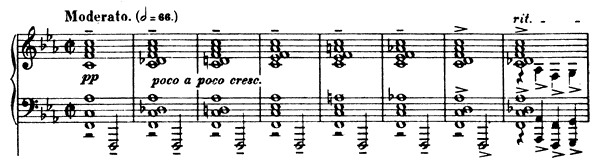
Chopin: Prelude opus 28 no 4
High Quality Piano Sheet Music
to Download and Print!
| ID:263
 | Get instant access to the printable sheet music of Prelude by Chopin and thousands of other classical piano pieces. Sign up for a Piano Street Gold Membership! |
|
|
Op.28 No.4 Chopin Prelude August 31, 2009, 09:25:19 PM by arpeggiated_chopin
|
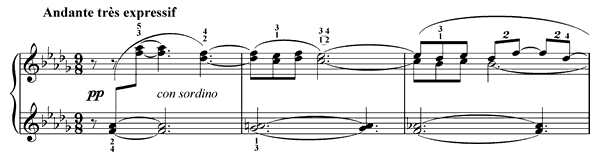
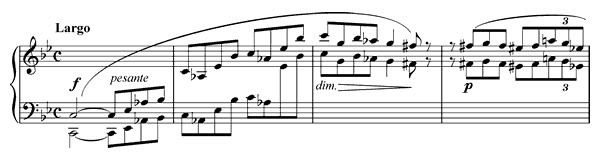
Hello everyone! This is my first post on this website, and I wanted it to be one of a question of mine. Recently, I've fallen in love with the 'clicking torture device' and I have been using it religiously when practicing exercises and pieces I'm working on. Recently I've been working on Chopin's Op.28 No.4 prelude, an easy one...Until measure seventeen! I was wondering if anyone else had ever encountered difficutly keeping in time with the big jump from b-b left hand octave to a-c natural-#d-f#. The suggested metronome marking in the Schirmer performance edition is 54-58 (Largo). When I slow it down to a snails pace of 45, I can manage it just fine, so I suppose the best thing to do is to practice the jump while incrementially increasing the metronome speed. Any suggestions, or past experiences studying this piece? Thanks a bunch. 
|
| Read More... | New Comment
|
|
Chopin - Op.28 n.4 June 01, 2009, 04:20:38 PM by pianist_on_the_ocean
|
This is a piece that I LOVE but unfortunately some hammers of my piano have to be changed, so I recorded it with all my heart altough the result. I hope you like it anyway.
p.s. I don't want to destroy Chopin beacause he'is my favourite composer, so if I did, advise me please! 
|
| Read More... | New Comment
|
|
|
Chopin prelude in e minor op.28. no.4 April 29, 2009, 12:41:54 PM by quaver
|
Does anyone have any suggestions how to play the left hand effectively. The chords are difficult to make each note sound. They mostly have three or four notes to a chord and I find that some will sound and others will not. Is arm weight the key here or constant practice to form the hand in the correct position for each note to sound. Perhaps a low wrist will do it. I dont know. Any suggestions on that one. Also measures 11 and 19. the grace note. Is that an appoggiatora or an accacciatora. Do I play the note as a crushed note or keep it longer. Thanks
|
| Read More... | New Comment
|
|
Two questions on Chopin Op 28 No 4 in e minor February 26, 2009, 11:37:49 PM by b0mbtrack
|
These are probably two really dumb questions but oh well. I'm doing pretty good reading and playing this one at the same time which is a real accomplishment for me but I just have two questions on it.
1) In measure 13 there is that triplet starting on D. Is the 4th beat on that D or is it mixed in there between the D and the C?
2) Why is the time signature is cut in half? Does that mean there are only two beats per measure and everything is 16th notes? That sounds like it would be really fast, but I don't play it like that.
|
| Read More... | New Comment
|
|
Chopin's Prelude op.28 n.4 - advice, please January 17, 2009, 12:17:50 PM by end
|
Hi,
I'm a beginner (less than a month with my piano), and I don't have a teacher (can't have one right now for several reasons).
I'm doing Suzuki book 1 and Czerny op. 599l as well as some Hanon exercises.
I was searching this forum for suggestions of easy pieces. Somebody suggested this prelude and I've taken a look. I fell in love with it and it didn't seem too difficult (the notes, because interpretation's something else!) and I got started right away.
I found really nice the fact that it's easy to sight read (I know a bit of music theory, because I study other instruments - classical guitar and violin), and sight reading I can "play" half of it already. I don't look at my hands and I try to listen to what I'm doing. Playing the notes is easy. However...
I know there's more to music than playing the notes...
I don't want to butcher the piece. I know, being a beginner, I'll do it, anyway, but I want to limit the damage.
So, would you please help me? I'm trying my best to respect the written music (all the details on the score) and I've been listening to it a lot to try and grasp the "music behind the notes". I'm paying attention to phrasing, listening to what I'm playing. But if you'd give me some tips, things a beginner wouldn't think of, wouldn't even see, I'd be most grateful.
How to do justice to this piece?
Some of you'll certainly feel offended I've even dared to think I could play it. If you feel this way, would you please suggest something else? Real music, only, please.
Thank you very much for any help at all.
|
| Read More... | New Comment
|
|
Chopin Prelude #4 (Em) fingering November 04, 2007, 08:12:12 PM by geschema
|
Is it mandatory to play the left hand chords legato?
I understand that one should look at the left hand notes not as chords but as three voices. While it's probably possible to find a fingering for the LH that enables legato playing, it will make the piece technically much harder to play. So, should I strive for it?
Also I would be very grateful for any online/book references about the Chopin Preludes.
Many thanks, Guy.
|
| Read More... | New Comment
|
|
Pedal help for Chopin E Minor Prelude Op. 28, No. 4 August 07, 2007, 07:47:56 PM by scrumhalf
|
I am learning this beautiful piece and am having a bit of trouble preventing the left hand from sounding choppy. I am using the pedal exactly as the sheet music markings indicate I should - for the measures where pedal use is indicated, I of course have no trouble making the repeated chords sound smooth and flowing, but for the measures where no pedal use is indicated, try as I might, I am having a hard time not making the chords sound choppy with gaps between them.
I never hear this when I hear recordings of this piece and while I have no illusions about my own skill level, I wonder if this is because others use the pedal more liberally than what the sheet music indicates. If I basically use the pedal everywhere, just release/ clarify at each chord change, it sounds much better, but I don't know if I am just using the pedal to cover up my lack of technique.
Any advice would be helpful!!
|
| Read More... | New Comment
|
|
Help on Chopin Prelude Opus 28 No 4 May 29, 2007, 09:47:51 PM by piano_monkey
|
I just started this piece (Chopin Prelude Opus 28 No 4) today and i'm a little stuck. In measure 16 there is a stop (I think that's what it is called) I have no experience in reading stops and don't know what to play. So the main point of the topic is how do you read stops (or whatever they're called)
Thanks in advance for your help
|
| Read More... | New Comment
|
|
|
Please click icons below to bookmark:
"Prelude opus 28 no 4 in E Minor by Frédéric Chopin"
| What customers said about pianostreet.com: |
"All of my students are members of Pianostreet and many of my teacher colleagues have joined as well.
It is an excellent resource for students and teachers alike and there is very rarely any need to visit another website or music store in search of sheet music."
Andrea Boltresz, piano teacher
Robertson, Australia |
"As a frequent user of pianostreet.com I find it easy to navigate, great value for money and very professional. The pieces are all well-graded and the audio is really useful, especially for pieces not heard before. I have recommended the site to many of my friends who play the piano. Keep up the good work."
Paul, Llansannan, UK. |
"Wonderful service! [...] I have no reservation in recommending it as a “must” to all pianists, both teachers
and students, amateur and professional."
Read full review >>
Dr. Robert J Keane, pianist
Australia
|
"I was in Poland the past summer to give 2 concerts. At the last minute they requested some Chopin, which I had not brought with me. So, I google-searched for classical downloads and found your site. I was able to print out excellent editions of the pieces I needed within minutes. To find the scores locally would have been inpossible as it was a smaller town, the nearest music store 45 minutes away."
Robert York, pianist
Long Beach, California |
"Piano Street has been a wonderful tool to me as both a pianist and a piano teacher. I can browse the collection for pieces I want to play and/or have my students play. The difficulty rating system that Piano Street uses enables me to search by difficulty level for pieces at my students' various playing levels. It is helpful that many of the scores include an audio clip of the piece being played. I have recommended to my advanced students that they also join Piano Street since getting sheet music from there is a much less expensive alternative to ordering and paying for the music.
Steve D. Allen, Ph.D.
Owner/Piano Teacher, Allen Music Studio
Houston, Texas
www.allenmusicstudio.net |
|
|