At University of California, Berkely, The Townsend Center’s Forum on the Humanities and the Public World presents eminent artists, political leaders, writers, and scholars, each representing a unique discipline, viewpoint, and medium. The series brings the humanities into dialogue with the critical issues at play in the public sphere. The Townsend Center at UC Berkeley has a long and distinguished tradition of humanistic scholarship, open dialogue, and pioneering innovation in the humanities. It is in this spirit that the Forum on the Humanities and the Public World presents leading figures from the academic and public worlds in settings designed for scholars and for the public at large.
On May 10th, 2010, the winner of the 1970 Chopin International Piano Competition, pianist Garrick Ohlsson gave a lecture there entitled; “Why Chopin? and Other Questions”.
In this conversation lecture Garrick Ohlsson discusses issues such as Chopin’s relationship to the piano (3.00), Chopin and period instruments (10.28), the “pianistic” Chopin (14.55), the Nocturnes (30.22) and performs the Nocturne in D-flat major Op. 27/2 (54.33).
In the final section he answers questions from the audience:
- On emotional contents, tempo and let go (1.01.12)
- Chopin and other composers (1.04.25)
- Chopin’s relation to opera and singing (1.08.00)
Chopin’s music has always posed a challenge to pianists. His compositions have retained a universal popularity and continue to be performed in virtually all corners of the world. They have been recorded and re-recorded in their thousands, so Chopin is apparently ‘well-represented’ – but many interpretative issues with respect to his music have yet to be addressed.
To gain further insight into his unique musical language and stylistic practices it is essential to comprehend as far as possible his expressed intentions. Our knowledge and appreciation of this most poetic of composers is greatly enriched by the combined study of not only his original manuscripts and related material (i.e. draft scores, early editions and annotated scores), but also the many statements made by his associates, friends and pupils who knew his playing and teaching principles. In addition to the considerable amount of general correspondence, reviews and reports of his concerts are revealing, although not always laudatory! especially from avid supporters of the ’sledge-hammer school’ as Chopin called them. To this list I feel it essential to include Polish folk-music, the wonderful songs and dances, and the historical development of the Polonaise, Rondo, Krakowiak and Mazur.
Most of us concert artists lead very busy lives so is it reasonable to ask whether or not it is really necessary to undertake the time-consuming task of such studies. To answer that question, one so often addressed to me, I would like to cite a single example of the wide disparities that exist between Chopin’s expressed intentions and the interpretative approach many pianists commonly adopt when playing his famous ‘Black Keys’ Study in Gb major, Op.10 No.5.
We are familiar with performances of this remarkable Study executed in brilliant style – played Allegro con brio/Presto with highly-charged forte dynamics, heavily accented and liberally pedalled – to suit the desired virtuosic display. This approach is, however, in direct opposition to Chopin’s original score markings and his concept of its interpretation. His score markings were actually given as leggierissimo elegatissimo (extremely light and delicate with a very smooth effect), carefully balanced against an unpedalled staccato l.h. accompaniment. The exaggerated dynamics and ‘express train’ tempo markings imposed on this Study are not to be found in the original manuscripts and so we have, regrettably, arrived at an opposing concept to that of the composer! To achieve the delicate lightness of touch required by Chopin is far more demanding technically, especially on the large concert grand pianos of today. There is also the problem of maintaining the tempo from the outset to include the double-octaves that descend in a final flourish of triplets. No slowing down of pace is indicated here by Chopin (or by any editors I know of), but it becomes inevitable when the overall tempo is taken too fast. Metronome markings applied to this Study generally in editions are not from the composer.
Etude in Gb major, Op.10 No.5: Opening bars from Chopin’s autograph manuscript. Reproduced by kind permission of The Chopin Society, Warsaw
Where score markings are correctly stated in publications his compositions still continue to fall prey to all manner of facilitating alterations in performance – perpetuated by generations of pianistic ‘tradition’ and stylisation. Unfortunately the variety of erroneous ‘revisions’ imposed on Chopin’s scores from pianists who arrogantly seek to remould his music into something that suits their purposes better are often praised. Interpretatively the easier performance options of ‘personalised interpretation’ with ‘flexibility of expression’- to the extent that originally written score directions are all but eclipsed – are too often defended. The idea of a carte blanche or ‘free for all’ when interpreting Chopin is often actively encouraged on the misguided premise that pretentious sentimentality and histrionic (mis)interpretations actually ‘improve’ Chopin’s compositions. To perceive Chopin as the archetypal Romantic languishing in a violet-scented mist of indecision about his scores is a misconception borne of spurious legend.
Chopin had very clear and definite views on adherence to his score details:
“Chopin could not bear anyone to interfere with the text of his works. The slightest modification was a gross error for which he would not pardon even his closest friends, not even his fervent admirer Liszt. The composer considered these alterations as a veritable act of sacrilege”. (Reported by Marmontel) [Chopin: 'Pianist and Teacher' by Jean-Jacques Eigeldinger]
Chopin occasionally pencilled an altered dynamic or variant into the scores of selected pupils during lessons but it was only his prerogative as the composer-pianist to make any such alterations. On the subject of the sentimentalise/Romantic approach, we know that he shunned all forms of excess or exaggeration and was never a Romantic composer in the Lisztian or Byronic sense. Rather his unique musical language and aesthetic belongs to earlier forms of art-music and Classicism. He revered the music of Bach and Mozart above all other composers – the significance of which should not be underestimated when playing Chopin.
It is vital from an artistic and aesthetic standpoint that the interpreter allows absolute priority to score directions and remains within the ‘guidelines’ marked on the texts by the composer. These provide our most fundamental link with his intentions. To clarify these ‘guidelines’, albeit simplistically, I refer to score indications that form the basis of an interpretation: e.g. that given sotto voce/pianissimo/piano markings are not substituted for a ‘preferred’ mezzo piano/mezzo forte/forte, or broad largo/lento tempos exchanged for the faster pace of an Allegretto etc.. Chopin was also strict about the observance of his precise phrase/slur markings and agogic signs, whilst pedalling ‘remains a study for life’, as he said, and requires constant consideration.
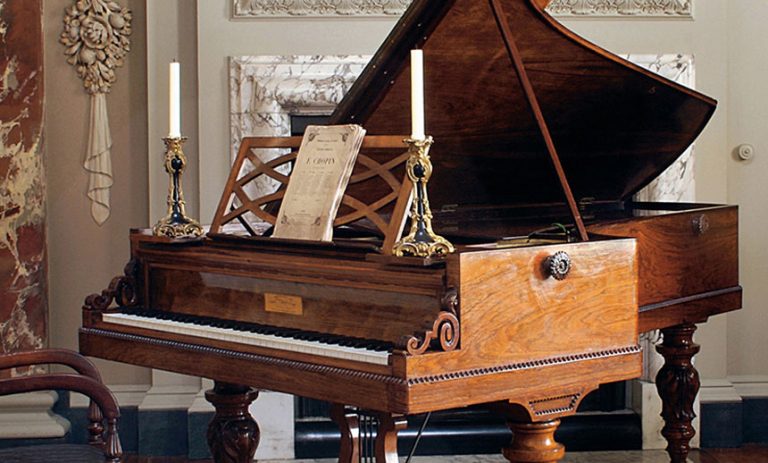
There are many instances where Chopin indicates extended pedal markings, often to create a veiled and almost impressionistic effect (e.g. in the introductory measures of the Polonaise-Fantaisie in Ab major, Op.61). Occasionally he would also indicate the pedal to be sustained through a change of harmony. These pedal indications need to be approached with some caution on the resonant and full-toned modern concert grand pianos, where the intended magical effects can become muddy and too thickly textured. It is a known fact that Chopin’s preference in pianos was for the ’silvery thin-toned’ Pleyel piano, which he also strongly recommended to his pupils. Unlike stringed instruments pianos do not stand the test of time, but having played two of Chopin’s Pleyel pianos it is evident that the sustaining pedal could be depressed through harmonic changes without any excessive blurring to the clarity of the writing.
It has also been remarked upon that Chopin rarely indicated use of the ’soft’ pedal una corda, although he often requires sotto voce and pianissimo/leggiero in his compositions. Apart from the important refinement of touch these quieter levels of tone require, the una corda pedal should be applied with discretion on the full-toned instruments.
Within the wide variety of musical terminology and signs that form our score instructions the expressive scope is comprehensive. It is evident from his manuscripts at least that Chopin left nothing to doubt for his copyists and editors, crossing out his rejected score details with thick webs of diagonal lines that render it impossible to decipher previously written details. In the words of Arthur Hedley, “He hesitated long before attaching a final indication of tempo or expression, so that no pianist has the right to treat these things as a simple matter of personal preference”. To further avoid misunderstanding Chopin would write a message on his score for the engraver to clarify his precise intentions. All of which proved no guarantee against errors from copyists and editors. An example of these errors can be found in the first C major Study from Op.10 where the original ms shows only two bars to be played forte – but most editions indicate forte throughout with accents added to each quadruplet in the r.h.. Chopin also wrote diminuendos for the re-entry of the main ‘theme’ and at the closing measures. These diminuendos are often correctly shown in editions, but are replaced with crescendos by most interpreters. The immense technical difficulties of playing the widely extended arpeggios in this Study are certainly facilitated if played relentlessly forte with unwritten sforzando bass octaves on a concert grand piano. But the question arises – is it what Chopin would have wanted….? For those who consider that the composer knew best how his music should be performed, the answer is clear.
There exists the ever-present predilection to sacrifice the ultimate realisation of Chopin’s art to personal whim. Wayward performances displaying an obvious ambivalence towards the text are often claimed as ‘great’ or even ‘definitive interpretations’ either for commercial purposes or from obvious misunderstandings of Chopin’s music. ‘Virtuosic’ displays of meaningless digital dexterity and the flashiness of excessively fast tempos, hard-hitting aggressively exaggerated dynamics and uncontrolled tempo deviations that debase and trivialise his music have become the facile recipes for accepted Chopin interpretations. This is not only seriously misleading to the public and untruthful but commits a grave disservice to the composer. The true art of Chopin playing presents a challenge that needs to be thoroughly reviewed and reassessed.
“Simplicity is everything.. After having played immense quantities of notes, and more notes, then simplicity emerges with all its charm, like art’s final seal. It is no easy matter.” Chopin.
(From a statement made by Chopin to his pupil Friedrike Streicher-Muller, who studied with the composer from October 1839-March 1841 and was the dedicatee of his Allegro de Concert,Op.46).
Great music should surely ennoble the spirit, create a moving experience and provide a lasting impression to reflect upon after the final notes have been played. To allow the composer to be revealed through the re-creation of his music must be the ultimate aim of an interpreter.
Contrary to their name, the four scherzos are not light-hearted compositions, and the first three, in particular the Scherzo in B minor, have very strong dramatic accents.
The first and last make the most of the ternary form, with extreme contrasts between the outer sections, full of restless motion, and the melodious middle episodes. The second and third scherzos shows Chopin’s ingenuity in creating new complex and dramatised forms, full of astonishing changes, sudden pauses and contrasts.
The most popular of these pieces is the B-flat Scherzo, opus 31. Chopin himself used it in his teaching and admonished his pupils to play the famous first bars in a manner that evoked the image of a mortuary.
Scherzo no 2 in B-flat Minor, opus 31:
The legendary pianist Arthur Rubinstein plays Scherzo no. 2:
The four Scherzos are now available as urtext scores to download and print from Piano Street’s online sheet music library.
Similar to the recently published collections of Nocturnes, Ballades and Preludes, this new edition by Piano Street attempts to present the most valid version of these pieces following consensus among today’s prominent scholars and pianists.
Ingolf Wunder is an exclusive artist of the label Deutsche Grammophon since February this year.
June 17, 2011 will see the release of his first CD on the label with works by Chopin for solo piano. Wunder’s debut CD with Chopin and Ravel’s Gaspard de la nuit was released in 2006 (ORF). He is prizewinner of numerous piano competitions; most notably receiving the first prizes at the Steinway-Wettbewerb in Hamburg, at “Prima la musica” in Feldkirch, Austria, and at the “Concours Musical de France” in Asti. He took part in the 36th International Liszt competition in Budapest and was awarded with the prize of the city of Budapest.
Successful at the Chopin competition 2010 in Warsaw, Ingolf Wunder showed his excellence in playing works by the great Polish composer. The young Austrian not only won the 2nd Prize but also several special prizes and the audience award at the legendary piano competition. The decision made by the jury led to an intensive public debate and received worldwide awareness. As prizewinner the 25 year old Wunder follows in the footsteps of many famous pianists like Martha Argerich, Garrick Ohlsson, Krystian Zimerman, Vladimir Ashkenazy, Mitsuko Uchida and Maurizio Pollini.
Ingolf Wunder was born in Klagenfurt. At the age of 4 he started his musical education playing the violin; however it was not until he was 14 that his extraordinary talent for the piano was discovered. He went to the conservatories in Klagenfurt and Linz, later he studied at the University of Music and Performing Arts in Vienna. Nowadays he is still regularly in touch with his mentor Adam Harasiewicz, the Polish pianist and winner of the Warsaw competition in 1955.
Being produced to commemorate the 200th anniversary of Chopin’s birthday, The Flying Machine takes the eternally fascinating and affecting Études, and crafts a celebration of the role that music and dance play in our lives, especially in our first pre-teen steps into the adult world.
The premier was a one-off film event at the Royal Festival Hall in London on February 12th & 13th with the sound track performed live by pianist Lang Lang.
The Flying Machine is the first 3-D film to be premiered inside a concert hall, and also the first film to combine live action and stop-motion in 3-D – and not least has the first 3-D sequence in a feature where the audience is inside a painting.
It is crafted for a multi-platform world with a feature film, several independent short films, an online game, live show and CD all to be released over the course of this year.
The feature film The Flying Machine will air on Sky 3D (UK) in May 2011.
The repertoire list can be sorted by clicking the table header links which can be useful for locating all performances of a specific pieces or by a specific pianist, such as for example locating all the 21 performances of the Ballade no 4 or the 19 peformances of Etude op 10 no 1!
The variations on a theme from Mozart’s opera Don Giovanni was the first of Chopin’s works to be published outside his own country. This is the piece Schumann reviewed with the famous words: “Hats off, gentlemen, a genius”
Read Schumann’s review: An Opus 2 – original article and translation
Preceeded by an introduction, the Fantasy includes a Polish popular song (Juz miesiac zaszedl), an air by the Polish composer Kurpinski and finally a Kujawiak (Mazurka). The work was published in 1834, dedicated to the pianist J. P. Pixis.
This concert Rondo, published in 1834, is built on a national dance from Cracovia – a simplified polonaise in 2/4 time. The piece begins with a soft, pentatonic melody before rushing into a more lively, syncopated dance which includes a quote of Paganini’s caprice no. 24.
The Polonaise in E-flat for piano and orchestra was written in 1830-31. A few years later Chopin composed the Andante spianato, a solo piano piece which was added as an introduction to the Polonaise and published as his opus 22 in 1836. Although the combined work was originally published for piano and orchestra it is often played as a solo piano piece.
Here is Kissin’s performance of the Andante spianato and Grande Polonaise Brilliante from the Verbier festival 2007:
Chopin composed about 200 works. 110 were dances such as mazurkas, waltzes and polonaises.
At the age of seven, he composed his first polonaise in B-flat major, and throughout his career he made the form exclusively his own, overshadowing the early examples by Oginski and Kurpinski. Chopin’s mature polonaises form a heroic national epic. In these works, Chopin’s patriotism envisions Poland’s former greatness and chivalric deeds. The form also became a means of expressing his most violent and angry emotions concerning his nation’s struggle. Chopin got it from his father, the dance, in its modern manifestation, from its godmothers; three French princesses of the 17th century who married successive Polish kings. The Polonaises, with their “cannon buried in flowers,” in Schumann’s words, have become symbolic and poignant evocations of an oppressed people. There are sixteen polonaises, of which nine were composed before Chopin left Poland at twenty-one. But only in Paris, idealizing his country from afar, could Chopin’s genius for the polonaise ripen.
Here we hear Rafal Blechacz playing the Polonaise in A-flat major Op. 53 “Heroique” in a live broadcast from the Polish Television. On October 21, 2005, he became the sole recipient of all five first prizes at the 15th International Frederick Chopin Piano Competition in Warsaw, taking First Prize and the polonaise, mazurka, sonata, and concerto first prizes. According to ABC News, one of the judges, Professor Piotr Paleczny, said that Blechacz “so outclassed the remaining finalists that no second prize could actually be awarded.”
Russia’s Yulianna Avdeeva won the prestigious 2010 International Frederic Chopin Piano Competition on Wednesday after a three-week musical marathon followed avidly by classical music lovers around the globe. The competition, the oldest of its kind in the world, is held every five years in the Polish capital and has built up an especially enthusiastic following in Asia. A jury that included several world-famous pianists such as Martha Argerich and Kevin Kenner chose Avdeeva, 25, from among 10 finalists after lengthy late-night deliberations at the end of a competition marked by the high quality of its performances.
Ingolf Wunder of Austria and Lukas Geniusas of Russia/Lithuania won joint second place, Russia’s Daniil Trifonov came third and Bulgaria’s Evgeni Bozhanov fourth.
Avdeeva, whose expressive and mature performance of Chopin’s Concerto in E minor drew a standing ovation on Tuesday evening, studied in Moscow and is now working as an assistant to a Russian professor at the Hochschule fuer Musik und Theater in Zurich, Switzerland. Avdeeva has performed in more than 20 countries including the United States and Japan and has won a number of prizes.
This year’s 16th Chopin competition attracted especially strong interest because it coincided with the 200th anniversary of the composer’s birth — to a Polish mother and French father — in a village near Warsaw in 1810. There were some 3,000 events including concerts dedicated to Chopin’s bicentenary worldwide in the first half of 2010 alone.
“MYSTIC QUALITY”
Of the 81 original finalists in this year’s Chopin Competition, selected after preliminary auditions in the spring, 16 were from Japan and 13 from China, highlighting Asia’s increasing clout in the field of Western classical music. However, no Asians were among the final 10 frontrunners playing before the 13-member jury in Warsaw’s National Philharmonia this week. That did not seem to cloud the excitement of the many Japanese, Korean and Chinese visitors to Warsaw.
“I have come here (to the Philharmonia) every day since I arrived in Poland. The level of playing is so high,” said Misato Ota, a piano teacher from Japan.
“We Japanese love Chopin for the delicacy and the mystic quality of his music,” she said, adding that she had wanted Polish finalist Pawel Wakarecy to win the competition.
The oeuvre of Chopin, called “Prince of the Romantics” by his most recent biographer Adam Zamoyski, ranges from elegiac sonatas to lively Mazurka folk dances.
Chopin left Poland at the age of 20 and spent most of his adult life in Paris but he remained a staunch patriot and his work is suffused with nostalgia for his homeland, at that time partitioned between Russia, Austria-Hungary and Prussia. In exile, he counted fellow composers Franz Liszt and Hector Berlioz and artist Eugene Delacroix among his friends. He had a turbulent love affair with the female novelist George Sand. Dogged by poor health, he died in 1849 aged just 39.
The International Fryderyk Chopin Piano Competition, the oldest of its kind in the world, is held every five years in the Polish capital Warsaw and is avidly followed by lovers of Chopin, the Franco-Polish composer and pianist who was born in 1810 in Zelazowa Wola near the Polish capital.
Eighty-one pianists from 23 countries are now competing for honours at the competition marking the bicentennial of the composer’s birth.
The competition runs until October 20 and hundreds of performances of Ballades, Nocturnes, Mazurkas and other piano pieces by Chopin are currently available to enjoy through the live competition webcast at konkurs.chopin.pl:
Update:
Who qualified for the second stage? Find out here!
The 2nd stage auditions will start on Saturday, the 9th of October and they will end on Wednesday, the 13th of October.
Chopin Express is an official, bilingual newspaper of the 16th International Fryderyk Chopin Piano Competition published by the Adam Mickiewicz Institute with the cooperation of the musical magazine „Gramophone”. The newspaper will be distributed for free during the whole Competition in the streets of Warsaw and in the Warsaw Philharmonic and are also available online as pdf.