Ludwig van Beethoven’s Piano Concerto No. 4 in G major, Op. 58, was composed in 1805-1806, although no autograph copy survives. The first movement opens with the solo piano, playing simple chords in the tonic key before coming to rest on a dominant chord. After a poetic pause of two and a half beats, the orchestra then enters in B major, the major mediant key, thus creating a tertiary chord change. This becomes a motif of the opening movement.
It was premiered in March 1807 at a private concert of the home of Prince Franz Joseph von Lobkowitz. The Coriolan Overture and the Fourth Symphony were premiered in that same concert. However, the public premiere was not until 22 December 1808 in Vienna at the Theater an der Wien. Beethoven again took the stage as soloist. This was part of a marathon concert which saw Beethoven’s last appearance as a soloist with orchestra, as well as the premieres of the Choral Fantasy and the Fifth and Sixth symphonies. Beethoven dedicated the concerto to his friend, student, and patron, the Archduke Rudolph.
Tip: Listen to the video without looking and see if you can recognize who is who of the pianists! In random order they are: Backhaus, Gould, Aimard, Gilels, Fleisher, Pletnev, Arrau, Haskil, Schnabel and Gieseking
A review in the May 1809 edition of the Allgemeine musikalische Zeitung states that “(the concerto) is the most admirable, singular, artistic and complex Beethoven concerto ever” (Allgemeine musikalische Zeitung, May 1809). However, after its first performance, the piece was neglected until 1836, when it was revived by Felix Mendelssohn.
Today, the work is widely performed and recorded, and is considered to be one of the central works of the piano concerto literature.
A legend among pianists of the twentieth century, Artur Schnabel (April 17, 1882 – August 15, 1951) was an Austrian pianist, who also composed and taught. Schnabel was known for his intellectual seriousness as a musician, avoiding pure technical bravura. Among the 20th century’s most respected and most important pianists, he displayed a vitality, profundity and spirituality in works by Beethoven and Schubert above all. His performances of these compositions have often been hailed as models of interpretative penetration; and his best-known recordings are those of the Beethoven piano sonatas.
Schnabel did much to popularize Beethoven’s piano music, making the first complete recording of the sonatas, completing the set in 1935. This set of recordings has never been out of print, and is considered by many to be the touchstone of Beethoven sonata interpretations. His interpretations of the late, visionary sonatas of Beethoven were spiritual testaments.
Artur Schnabel’s editing of the complete Beethoven piano sonatas (1000+ pages total) stands as one of the most unlikely and yet colossal resources of pianistic wisdom generally and piano technique in particular ever compiled. The original edition of the 32 Sonatas edited by Schnabel was published in Milan, Italy by Edizioni Curci in three volumes. A re-engraved and corrected two-volume, five-language (English, French, German, Italian, and Spanish) American edition is available from Amazon.com
Hear Schnabel play the three last Sonatas of Beethoven:

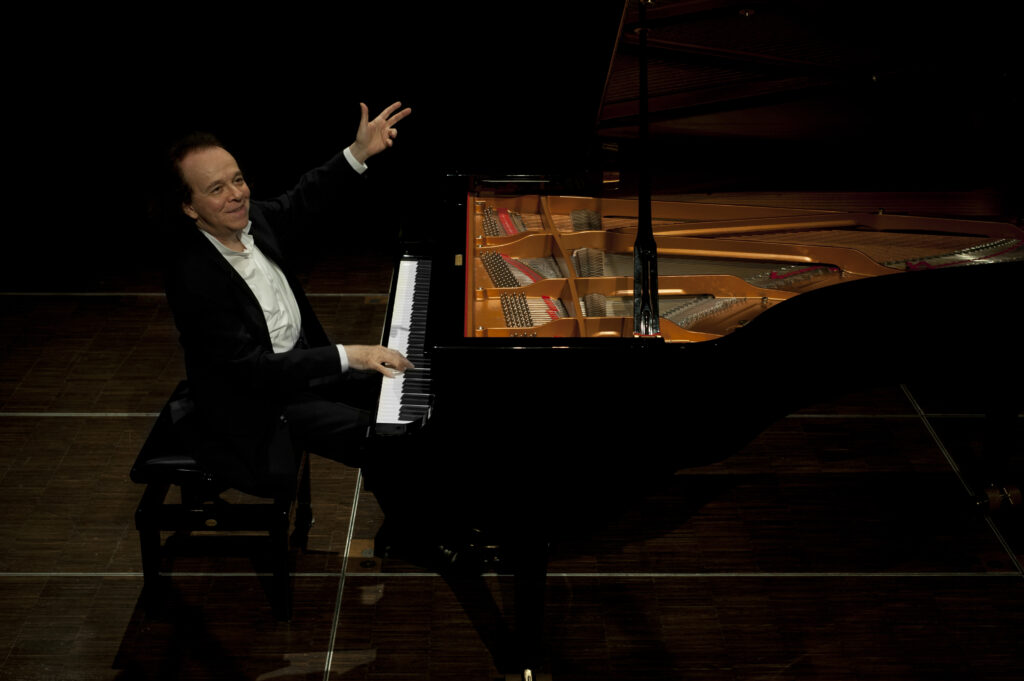
Ronald Brautigam talks to Piano Street’s Patrick Jovell about his love and interest in period instruments as well as the modern grand piano.

Patrick: We know you as one of the most important contemporary fortepiano exponents of Mozart, Haydn and Beethoven, which has resulted in your recording these composers’ complete sonatas on the BIS label. I have also experienced your outstanding chamber music collaborations, for example with violininst Isabelle van Keulen and your numerous prizewinning recordings of concerti on a modern grand piano. Your complete Beethoven piano concertos project has also achieved completion, and the recording of the E-flat major concerto no. 5 and Choral Fantasy has been available in record stores since July. One might say that you are a pianist with one foot in the past and one foot in the present. How did your love for and interest in period instruments emerge?


Ronald: The music of Haydn, Mozart and Beethoven has always held a special place in my repertoire, long before I became interested in the fortepiano. It was during the 1980s that playing Mozart’s piano sonatas became something of a problem: I had a clear idea of how the music should sound, but somehow the end result never matched my preconceived interpretation. The music sounded too big for what it was, and trying to make it lighter only resulted in the sort of polished and overly elegant Mozart I absolutely can’t stand. It was not until in 1987 that I came across fortepiano builder Paul McNulty (www.fortepiano.eu), who had his workshop in Amsterdam at the time. He invited me to come and have a look at his newly-finished 5-octave Walter copy. As soon as I started playing some Mozart, it all fell into place: the lightness I had been looking for was there, along with a sense of drama, of cheekiness and excitement I had never dreamed to find in these sonatas. All in all it only took me half an hour of playing to order an instrument from Paul; a decision that definitely changed my life. I had originally planned to keep my fortepiano at home, to use it as a reference when preparing a concert on modern piano. But in the end I found myself behind the fortepiano most of the time, and decided to start using it for concerts. The beginning of a long and happy relationship!


Patrick: All pianists, to different extents, have personal experience of Mozart, Haydn and Beethoven sonatas throughout their lives, including discussions and reflections about how to read the score. As a top level pianist, you have played these sonatas since childhood. How do you approach the text when you prepare a work on the fortepiano as compared with how you prepared it previously? Are there basic rules or inevitable facts that have to be considered in a fortepiano situation?


Ronald: There is not really a lot of difference in my text approach on fortepiano or on modern piano. The text is the most important information the composer left us, and tells us everything we should do, whether on a Walter or a Steinway. Playing on a fortepiano, the instrument the composer had in mind, we can simply interpret the score as it is written. It is when playing a modern piano that we have to rethink some elements of the score, make a translation, as it were. Playing Beethoven on a fortepiano takes the instrument to its dynamic limits, which is not advisable to try on a Steinway!


Patrick: So how does the actual translation/transition work in practice?


Ronald: We have to convert the original dynamics into something that works equally well on a modern instrument, and the same goes for the accents, sforzati, etc. This practically means that you have to be more careful on a modern piano, without losing the excitement and dynamic drama of playing a period instrument. I tend to use far more leggiero and staccato playing on a modern piano, to suggest some of the crispness of a fortepiano, and I try to avoid the big, romantic sound as much as possible. But in the end the intrinsic qualities of whichever instrument you use should never be thrown overboard. Play a Steinway as a Steinway, play a Walter as a Walter.


Patrick: Your intentions as an interpreter clearly have to be treated differently in various situations. Can you elaborate on this?


Ronald: Well, I have also found that each instrument has its own sense of ‘tempo giusto’. An adagio will somehow be played slower on a Steinway than on a Walter, simply because of what the ear picks up. A performer constantly assesses the sound coming out of the piano, is forever making small adjustments to tempo and dynamics according to what he hears. When a note dies out on a fortepiano, the following note in the melody will come sooner, to keep the melody flowing. On a Steinway, where the length of the melody note seems endless, the timing of the following note will naturally be different, resulting in a slightly slower tempo. The much lighter action of a fortepiano makes for crisp, fast tempi that could never work on a modern piano.
The third, and final element where there is a difference in approach is articulation. Owing to its quick damper action and shorter tone, a fortepiano has a speaking quality, whereas a modern piano is by nature a singing instrument. Articulation on a fortepiano is an organic part of its speech, on a Steinway it can sometimes feel a bit ‘amputated’: just as the tone is getting ready to give it a go, it is cut off. This asks for a slightly more conservative handling of the articulation on a modern piano; as I said before, never do anything against the character of an instrument. Again, you have to make a translation of the original articulation into something that suits a modern piano.

Patrick: Thank you for taking the time talking to us and good luck with your projects and concerts!


Ronald: You’re welcome, the pleasure was all mine!
Ronald Brautigam, fortepiano, and Die Kölner Akademie under Michael Alexander Willens recording Mozart Piano Concertos in Cologne, November 2009:


Video from BBC, Ronald Brautigam plays W.A. Mozart´s Piano Concerto no. 20 in D minor, mvt 3 performed on a pianoforte:


More Ronald Brautigam on fortepiano:

Beethoven’s Complete Works for Piano and Orchestra Now Available
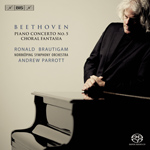
For the final instalment of his survey of Beethoven’s works for piano and orchestra on BIS label, Ronald Brautigam has saved ‘the final crowning glory of his concerto output’, as Beethoven specialist Barry Cooper describes the Fifth Piano Concerto in his liner notes. The work has become known as the Emperor Concerto, as it shares its key (E flat major) as well as a certain sense of power and grandeur with the Third Symphony, the ‘Eroica’. It is coupled on this disc with the Choral Fantasia – an intriguing work scored for piano, orchestra and chorus with vocal soloists. The explanation for this unusual combination is that Beethoven wanted to provide a fitting finale for one of his mammoth concerts in Vienna. The concert, which took place on 22 December 1808, included performances of the Fifth and Sixth Symphonies as well as the Fourth Piano Concerto and two movements from the Mass in C major; the Choral Fantasia thus brought all of the evening’s performers on stage once more before the end of the concert.
The individual discs in Ronald Brautigam’s series have received numerous distinctions, including a MIDEM Classical Award in 2010, and his performances have been weighed against classic recordings by legendary pianists. “Brautigam’s account [of Concerto No. 1] compares with Richter’s for sparkle, with Pollini’s for cleverness, and with Michelangeli’s for liveliness… The performance of Beethoven’s Third Concerto that follows is even better”, wrote the reviewer on website AllMusic.com, while the one in Gramophone deemed that the recording of the Second Concerto was “almost as good as Serkin’s account with Ormandy, which is saying something!”
In the review in International Record Review of the penultimate volume, finally, the series so far was summed up as follows: “For my money, Brautigam and Parrott are setting a new bench-mark, and I eagerly await the final instalment.”
It is of course a great pleasure to be able to announce the release of that longed-for disc, with Ronald Brautigam, the Norrköping Symphony Orchestra and Andrew Parrott in their usual top form, and with the brief but crucial appearance of the eminent Eric Ericson Chamber Choir in the Choral Fantasia.
As mentioned in February on Piano Street’s blog, Brautigam’s prizewinning CD is one of the recordings which Ronald Brautigam made for the Swedish recording company BIS. This CD contains the two earliest composed concerti of which the second piano concerto was written earlier than the first and then edited later which explains the numbering. The first of these is the Piano Concerto in E flat major, WoO4, sometimes referred to as Beethoven’s “Concerto No.0″. Composed in 1784, when Beethoven was only 13 years old, it is a fully developed three-movement work that displays much imagination, harmonic control and sense of form, as well as a striking level of virtuosity. The work has survived in a contemporary copy of the piano part, incorporating directions showing that the original orchestra consisted of two flutes, two horns, and strings.
For this recording Ronald Brautigam has made his own reconstruction of the orchestral score. The third work on the disc is also one without opus number, namely the Rondo in B flat major, WoO6, composed during the long gestation of Concerto No.2 and probably at one stage intended as the finale of this work.

Brautigam´s reconstructed E flat major, WoO4, the score is available for purchase from Alba Music Press
Stephen Kovacevich (born 1940), who has also been known as Stephen Bishop and Stephen Bishop-Kovacevich is an American classical pianist and conductor. He was born in San Pedro, Los Angeles, California, to a Croatian father and an American mother.
He made his concert debut as a pianist at the age of 11; then, at the age of 18 he moved to London to study under Dame Myra Hess on a scholarship, and has been a London resident ever since, and is currently living in Hampstead.
As a soloist and conductor, he is probably best known for his interpretations of the core classical repertoire, including Mozart, Beethoven, Schubert, Brahms and Bartók. His international reputation has been built both on his concert appearances, renowned for their thoughtfulness and re-creative intensity, and on the highly acclaimed recordings he has made throughout his career.
Watch the complete recital at Medici TV: http://www.medici.tv/#/movie/27/
Program:
Beethoven – Two Sonatas (op 110 and op 111) and two Bagatelles
Schubert – Ländler
Schubert: Impromptu in G flat major, opus 90 no 3
Extract from Stephen Kovacevich’s masterclass on two of the Op 90 Schubert Impromptus. Full DVD will be shortly available from www.masterclassfoundation.org
Variation form was a central feature of Beethoven’s piano writing in general, from his early years until the end of his life.
The many witty transformations of popular tunes give us an insight in how it might have sounded when the young Beethoven sat down to improvise at the keyboard, while works like the Eroica- and Diabelli Variations belong to the composer’s mature masterworks.
“It is not just sound. The problem is that this content cannot be really be articulated in an objective, rational, scientific way — with words.
If it were possible to articulate it in an objective, rational, scientific way, the music would not be necessary.”
In the Masterclasses series with Daniel Barenboim, he speaks about what
it is and what it takes to truly play Beethoven. Lang Lang, a younger
colleague playing the Piano Sonata No. 23 in F minor, Appassionata, gets
some intense advice on how to reflect on different interpretational aspects.
Daniel Barenboim is not the only one to have successfully had the complete Beethoven sonatas on his agenda lately.
A Grammy nominee for “Best Classical Album (Without Orchestra)” for the second volume of his Complete Beethoven Sontata recordings for ECM, András Schiff began in 2004, a series of performances in Europe in which he explored the 32 Beethoven piano sonatas in chronological order – a project recorded live for ECM New Series, to be released in eight volumes in 2009. Garrick Ohlsson performed the whole cycle at eight concerts at the Verbier Festival in Switzerland in 2005 and at Tanglewood in 2006. He will release the last volume in his Beethoven series during 2009 on the Bridge label. Notably, volume three was awarded a Grammy for “Best Classical Instrumental Soloist (Without Orchestra )” in 2008.
András Schiff was born in Budapest, Hungary, in 1953. He began piano lessons at the age of five with Elisabeth Vadász and continued his musical studies at the Ferenc Liszt Academy with Professor Pál Kadosa, György Kurtág and Ferenc Rados; he also studied with George Malcolm in London. Recitals and special projects take him to all of the international music capitals and include cycles of the major keyboard works of Bach, Haydn, Mozart, Beethoven, Schubert, Schumann, Chopin and Bartók. Schiff has established a prolific discography, including recordings for Teldec (1994-1997), London/Decca (1981-1994) and, since 1997, ECM New Series. Recordings for ECM include the complete solo piano music of Beethoven and Janácek, a solo disc of Schumann piano pieces and his second recording of the Bach Goldberg Variations. He has received several international recording awards, including two Grammy Awards for “Best Classical Instrumental Soloist (Without Orchestra)” for the Bach English Suites, and “Best Vocal Recording” for Schubert’s Schwanengesang with tenor Peter Schreier.
Since his triumph at the 1970 Chopin International Piano Competition, American pianist Garrick Ohlsson has become established worldwide as a musician of extraordinary interpretive power and prodigious technical facility.
Although he has long been regarded as one of the world´s leading exponents of the music of Chopin, Mr. Ohlsson has an enormous repertoire that encompasses virtually the entire piano literature. A student of the late Claudio Arrau, Mr. Ohlsson is noted for his masterly performances of the works of Mozart, Beethoven and Schubert, as well as the Romantic repertoire. Mr. Ohlsson’s concerto repertoire alone is unusually wide and eclectic, ranging from Haydn and Mozart to 20th-century masters, and to date he has at his command some 80 works for piano and orchestra.
The New York Times asked Garrick Ohlsson to share his insights into Beethoven’s sonatas. In this series of features recorded in the WQXR studios, Mr. Ohlsson takes listeners on a journey through each of the sonatas, playing excerpts and talking about the music and the composer: Garrick Ohlsson on Beethoven’s Sonatas
Dudley Moore (1935 – 2002), was an English actor, comedian and musician.
Moore first came to prominence as one of the four writer-performers in Beyond the Fringe in the early 1960s and became famous as half of the hugely popular television double-act he formed with Peter Cook.
His musical talent won him a scholarship to Magdalen College, Oxford and whilst studying music and composition there, he performed with Alan Bennett in the Oxford Revue. Bennett then recommended him to the producer putting together Beyond the Fringe, a comedy revue, where he was to first meet Peter Cook. Beyond the Fringe was at the forefront of the 1960s satire boom and after enormous success in Britain, it transferred to the USA where it was also a major hit. His fame as a comedic actor was later heightened by his success in Hollywood movies such as 10 with Bo Derek and Arthur in the late 1970s and early 1980s, respectively.
Moore was nominated for a Best Actor Academy Award but lost to Henry Fonda (for On Golden Pond). He did, however, win a Golden Globe award for Best Actor in a Musical/Comedy. In 1984, Moore had another hit, starring in the Blake Edwards directed Micki + Maude, co-starring Amy Irving. This won him another Golden Globe for Best Actor in a Musical/Comedy.
In addition to acting, Moore continued to work as a composer and pianist, writing scores for a number of films and giving piano concerts, which were highlighted by his popular parodies of classical favourites. In addition, Moore collaborated with the conductor Sir Georg Solti to create a 1991 television series, Orchestra!, which was designed to introduce audiences to the symphony orchestra. He later worked with the American conductor Michael Tilson Thomas on a similar television series from 1993, Concerto!, likewise designed to introduce audiences to classical music concertos.
In 1987, he was interviewed for the New York Times by the music critic Rena Fruchter, herself an accomplished pianist. They became close friends. At that time Moore’s film career was already on the wane. He was having trouble remembering his lines, a problem he had never previously encountered. He opted to concentrate on the piano, and enlisted Fruchter as an artistic partner. They performed as a duo in the U.S. and Australia. However, his disease soon started to make itself apparent there as well, as his fingers would not always do what he wanted them to do.
In June 2001, Moore was appointed a Commander of the Order of The British Empire (CBE). Despite his deteriorating condition, he attended the ceremony, mute and wheelchair-bound, at Buckingham Palace to collect his honour.
This clip is from the 1950’s-60s British comedy group “Beyond the Fringe. Dudley Moore plays a very funny but also musically ambitious parody of a Beethoven piano sonata based on very odd yet well-known thematic material.
Ludwig van Beethoven’s supposedly “last piano work” has been found by musicologist Peter McCallum, while studying the composer’s final music sketchbook at the Berlin’s state library.
The 32 bars piece was found in the so called “Kullak sketchbook”, one of Beethoven’s working documents full of ideas, jotted notes and musical fragments. Mr McCallum noticed what he calls the “Bagatelle in F minor” in the middle of Beethoven’s sketches for the String Quartet Op. 135.
Obviously it wasn’t clear it was a piano piece instantly because Beethoven often used a chaotic sort of shorthand.
Mr McCallum said he believed the piece was written in October 1826, a few months before Beethoven’s death in March 1827.
“I didn’t know it was a piano piece until I actually sat down and tried to write it out,” says McCallum. “Beethoven almost never used clefs or key signatures so you have to think about it … but once you do crack the code it’s clear.” Mr McCallum adds.
Mr McCallum’s pianist wife Stephanie used her husband’s transcription to make the first recording of the piece—Bagatelle in F minor—which is just 54 seconds.
First recording by Australian pianist Stephanie McCallum is available online here.
Unlike Mozart who worked out his compositions in his mind and then wrote them straight off, Beethoven kept private notes all his working life in which each composition grew from initial idea through constant revision, bar by bar, until he achieved a final version.
One of Beethoven’s other sketchbooks, “Landsberg 5″ from 1809, including over 100 pages of sketches will soon be available as a downloadable pdf from Piano Street.
It includes sketches for one of his Piano Concertos, the Piano Sonata Op 81 and much more. Deciphering Beethoven’s rather sloppy handwriting is definitely not an easy task and by studying these sketches you will get an idea of the expertise needed for making discoveries such as McCollum’s but one first step is to take the challenge and figure out…
Which Piano Concerto theme is hiding on page 14 of the Landsberg 5 sketchbook?
Send your answer (specify movement) to webmaster@pianostreet.com before Sunday 30 November and, if correct, you will get a free copy of the Landsberg 5 sketchbook (pdf-file) when it becomes available at Piano Street.
Special prize draw: Three people submitting the correct answer will each get one year of Piano Street Gold membership (value 36 USD).
Uptate 8 December:
The correct answer is Piano Concerto no 5, 3rd mvt and the lucky winners of Gold memberships are: