La Linea (”The Line”) is an Italian animated series created by the Italian cartoonist Osvaldo Cavandoli. The series consists of 90 episodes which are about 2–3 minutes long each and were originally broadcast in the Italian channel RAI between 1972 – 1991. Over the years the series aired in more than 40 countries around the world. Due to its short duration (usually 2 minutes 30 seconds), it has often been used in many networks as an interstitial program.
Even though the episodes are numbered up to 225, there are, in fact, only 90 La Linea episodes. The Lagostina series had eight (5 min) episodes, the 100 series had 56 (101-156), and the 200 series had 26 (200-225).
The cartoon features a man (known as “Mr. Linea”) drawn as a single outline around his silhouette, walking on an infinite line of which he is a part. The character encounters obstacles and often turns to the cartoonist to draw him a solution, with various degrees of success. One recurring obstacle was an abrupt end of line. The character would often almost fall off the edge into oblivion and get angry with the cartoonist and complain about it. He was voiced by Carlo Bonomi in a mock version of Milanese that resembled gibberish as much as possible, giving the cartoon the possibility to be easily exported without dubbing. The tune played in the background of the series was created by Franco Godi but in this episode we hear Mr. Linea perform Mozart’s Sonata K 545 in C major.
2011 Grammy Award for Best Instrumental Soloist Performance with Orchestra:
Mozart, Piano Concertos Nos. 23 and 24
Mitsuko Uchida, Cleveland Orchestra (Decca)
Pianist Dame Mitsuko Uchida has just won her first-ever Grammy award. The recording, Mozart: Piano Concertos nos. 23 & 24, was released in the US on September 8, 2009 and is one in a series of recordings of Mozart concertos with Uchida planned on Decca. The Guardian wrote about this recording: “Admirers of Uchida’s fabulously fluent Mozart playing will know what to expect from these accounts; every phrase is elegantly tooled, every texture perfectly weighted … a rapturously beautiful disc.” Mitsuko Uchida has long been one of the world’s premiere interpreters of Mozart’s piano music both in the recording studio and the concert hall. She famously recorded the Mozart Concertos with Jeffrey Tate and the English Chamber Orchestra in the 1980s.
Recently, Uchida has decided to reconsider the works and now records them live with the Cleveland Orchestra in Severence Hall with the pianist also acting as conductor. This new approach in both logistics and style has yielded results which few could have imagined. “Mitsuko Uchida’s Mozart playing here is stunningly sensitive, crystalline, and true. These two concertos have been over-recorded, but this soloist and this great orchestra prove there is still more to say.” (Boston Globe – Record Review)
The next recording in this series, Mozart: Piano Concertos nos. 20 & 27, will also feature the Cleveland Orchestra and Uchida as both conductor and soloist and will be released later this spring.
Uchida said about the award, “I feel very happy about receiving this Grammy Award, especially because it is for the first recording in a series of Mozart concerti with The Cleveland Orchestra. These are people with whom I have a long association, so it gives me particular pleasure.”
Here is an example of Uchida playing Mozart from a live concert during Salzburger Festspiele 2006: W. A. Mozart – Piano concerto No 25 (Uchida, Vienna Philharmonic, Muti)
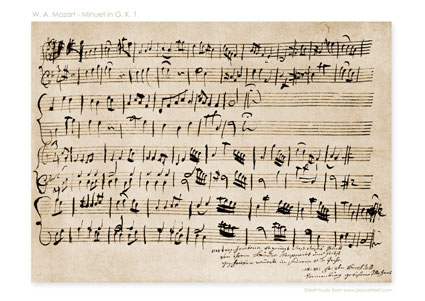
We celebrate your birthday, Mozart, with a little gift to all your fans, a facsimile of one of your first pieces, Minuet in G, K 1.
Print out and play!!
Mozart’s 255th! 12 Wolfgang Amadeus Mozart Quotables “January 27th marks Wolfgang Amadeus Mozart’s 255th birthday, offering a perfect excuse for us to pull out some of our favourite quotes from Wolfie himself and a few well-deserved words from his multitude of admirers”: http://www.classical963fm.com/blog/mozart-quotes-birthday
Mozart’s Thematic Catalogue – Introduction
This manuscript is Mozart’s record of his compositions in the last seven years of his life, and thus is a uniquely important document.
During this period, from February 1784 until December 1791, he composed many of his best-known works, including his five mature operas, several of his most beautiful piano sonatas, and his last three great symphonies, as well as several famous lesser works.
Mozart organised the entries in the catalogue in the order in which they were completed. On the left-hand page he entered five compositions, each with its date, title, and often its instrumentation. http://www.bl.uk/onlinegallery/ttp/mozart/accessible/introduction.html
Did you listen to Mozart today? Please share your favourite Mozart links, a greeting or your thoughs about Mozart’s music by posting a comment here or on our Facebook page!
Acclaimed as one of the greatest interpreters of Mozart, Portuguese/Brazilian pianist Maria-João Pires (b. 1944) is an artist who combines exquisite stylistic refinement with a serious effort to plumb the intellectual complexities and spiritual depths of music. Refusing to conform to the traditional image of a concert virtuoso, Pires emphasizes the spiritual dimensions of music, always searching for hidden meanings which may elude the analytical performer. This remarkable reverence towards works of music, clearly manifested in her performances of Mozart, was made explicit by her remark that, as a performer, she acts as a channel for the composer’s ideas.
Her recording of Mozart’s complete sonatas received the 1990 Grand Prix du Disque. One of her highly acclaimed recordings is “Mozart: The Piano Sonatas”. According to the Penguin Guide: “Maria João Pires is a stylist and a fine Mozartian. She is always refined yet never wanting in classical feeling, and she has a vital imagination. She strikes an ideal balance between poise and expressive sensibility, conveying a sense of spontaneity in everything she does”.
*** Live Video – Limited Availability ***
Maria-Joao Pires and Chamber Orchestra of Europe perform Mozart’s Piano Concerto no 27 in B-flat major K. 595. Video available until January 29 2011:
W. A. Mozart´s last piano concerto No. 27 in B flat major K. 595 followed by some years the series of highly successful concertos Mozart wrote for his own concerts, and by the time of its premiere Mozart was no longer so prominent a performer on the public stage. It is a popular assumption that this concerto was first performed at a concert on 4 March 1791 in Jahn´s Hall by Mozart and by a clarinetist Joseph Bähr.
Seen from today’s state of scholarship however there is absolutely no proof that Mozart actually performed K. 595 on this day. The concert might well have been premiered by Mozart’s pupil Barbara Ployer on the occasion of a public concert at the Auersperg palace in January 1791.
This was Mozart’s last appearance in a public concert, as he took ill in September 1791 and died on 5 December 1791. The manuscript is dated 5 January 1791. However, Alan Tyson’s analysis of the paper on which Mozart composed the work indicated that Mozart used this paper between December 1787 and February 1789, which implies composition well before 1791. Perhaps the most controversial aspect of the concertos is the extent to which Mozart (or other contemporary performers) would have embellished the piano part as written in the score. Mozart’s own ability to improvise was famous, and he often played from very sketchy piano parts. Furthermore, there are several very “bare” parts in the concerto scores that have led some to deduce that the performer is meant to improvise embellishments at these points, the most notorious being towards the end of the F sharp minor second movement of No. 23 in A major (K. 488) (the end of the first subject of the second movement of No. 24 in C minor, K. 491 is another example). Manuscript evidence exists to suggest that embellishment did occur (e.g. an embellished version of the slow movement of No. 23, apparently by his gifted pupil Barbara Ployer). In 1840, evidence was published from two brothers, Philipp Karl and Heinrich Anton Hoffmann, who had heard Mozart perform two concertos, Nos 19 and 26 (K. 459 and K. 537) in Frankfurt am Main in 1790. Philip Karl reported that Mozart embellished his slow movements “tenderly and tastefully once one way, once another according to the momentary inspiration of his genius”, and he later (1803) published embellished Mozart slow movements to six of his later concertos (K. 467, K. 482, K. 488, K. 491, K. 503 and K. 595).
Ronald Brautigam talks to Piano Street’s Patrick Jovell about his love and interest in period instruments as well as the modern grand piano.
Patrick: We know you as one of the most important contemporary fortepiano exponents of Mozart, Haydn and Beethoven, which has resulted in your recording these composers’ complete sonatas on the BIS label. I have also experienced your outstanding chamber music collaborations, for example with violininst Isabelle van Keulen and your numerous prizewinning recordings of concerti on a modern grand piano. Your complete Beethoven piano concertos project has also achieved completion, and the recording of the E-flat major concerto no. 5 and Choral Fantasy has been available in record stores since July. One might say that you are a pianist with one foot in the past and one foot in the present. How did your love for and interest in period instruments emerge?
Ronald: The music of Haydn, Mozart and Beethoven has always held a special place in my repertoire, long before I became interested in the fortepiano. It was during the 1980s that playing Mozart’s piano sonatas became something of a problem: I had a clear idea of how the music should sound, but somehow the end result never matched my preconceived interpretation. The music sounded too big for what it was, and trying to make it lighter only resulted in the sort of polished and overly elegant Mozart I absolutely can’t stand. It was not until in 1987 that I came across fortepiano builder Paul McNulty (www.fortepiano.eu), who had his workshop in Amsterdam at the time. He invited me to come and have a look at his newly-finished 5-octave Walter copy. As soon as I started playing some Mozart, it all fell into place: the lightness I had been looking for was there, along with a sense of drama, of cheekiness and excitement I had never dreamed to find in these sonatas. All in all it only took me half an hour of playing to order an instrument from Paul; a decision that definitely changed my life. I had originally planned to keep my fortepiano at home, to use it as a reference when preparing a concert on modern piano. But in the end I found myself behind the fortepiano most of the time, and decided to start using it for concerts. The beginning of a long and happy relationship!
Patrick: All pianists, to different extents, have personal experience of Mozart, Haydn and Beethoven sonatas throughout their lives, including discussions and reflections about how to read the score. As a top level pianist, you have played these sonatas since childhood. How do you approach the text when you prepare a work on the fortepiano as compared with how you prepared it previously? Are there basic rules or inevitable facts that have to be considered in a fortepiano situation?
Ronald: There is not really a lot of difference in my text approach on fortepiano or on modern piano. The text is the most important information the composer left us, and tells us everything we should do, whether on a Walter or a Steinway. Playing on a fortepiano, the instrument the composer had in mind, we can simply interpret the score as it is written. It is when playing a modern piano that we have to rethink some elements of the score, make a translation, as it were. Playing Beethoven on a fortepiano takes the instrument to its dynamic limits, which is not advisable to try on a Steinway!
Patrick: So how does the actual translation/transition work in practice?
Ronald: We have to convert the original dynamics into something that works equally well on a modern instrument, and the same goes for the accents, sforzati, etc. This practically means that you have to be more careful on a modern piano, without losing the excitement and dynamic drama of playing a period instrument. I tend to use far more leggiero and staccato playing on a modern piano, to suggest some of the crispness of a fortepiano, and I try to avoid the big, romantic sound as much as possible. But in the end the intrinsic qualities of whichever instrument you use should never be thrown overboard. Play a Steinway as a Steinway, play a Walter as a Walter.
Patrick: Your intentions as an interpreter clearly have to be treated differently in various situations. Can you elaborate on this?
Ronald: Well, I have also found that each instrument has its own sense of ‘tempo giusto’. An adagio will somehow be played slower on a Steinway than on a Walter, simply because of what the ear picks up. A performer constantly assesses the sound coming out of the piano, is forever making small adjustments to tempo and dynamics according to what he hears. When a note dies out on a fortepiano, the following note in the melody will come sooner, to keep the melody flowing. On a Steinway, where the length of the melody note seems endless, the timing of the following note will naturally be different, resulting in a slightly slower tempo. The much lighter action of a fortepiano makes for crisp, fast tempi that could never work on a modern piano. The third, and final element where there is a difference in approach is articulation. Owing to its quick damper action and shorter tone, a fortepiano has a speaking quality, whereas a modern piano is by nature a singing instrument. Articulation on a fortepiano is an organic part of its speech, on a Steinway it can sometimes feel a bit ‘amputated’: just as the tone is getting ready to give it a go, it is cut off. This asks for a slightly more conservative handling of the articulation on a modern piano; as I said before, never do anything against the character of an instrument. Again, you have to make a translation of the original articulation into something that suits a modern piano.
Patrick: Thank you for taking the time talking to us and good luck with your projects and concerts!
Ronald: You’re welcome, the pleasure was all mine!
Ronald Brautigam, fortepiano, and Die Kölner Akademie under Michael Alexander Willens recording Mozart Piano Concertos in Cologne, November 2009:
Video from BBC, Ronald Brautigam plays W.A. Mozart´s Piano Concerto no. 20 in D minor, mvt 3 performed on a pianoforte:
An early piano believed to have been played by Wolfgang Amadeus Mozart has surfaced in Germany and could be worth millions of euros, a radio station reported.
Public broadcaster SWR said the instrument was built in 1775 and acquired in the 1980s by piano manufacturer Martin Becker in the southern German city of Baden-Baden from an antiques dealer in Strasbourg, eastern France. When Becker decided to auction off the fortepiano, a music historian noticed the offer and “had a hunch that it could be the same long-lost instrument that Mozart played whenever he was in Strasbourg,” SWR said. “I had the idea to offer it on (online auction site) eBay and maybe get between 30,000 and 40,000 euros for it,” Becker told the radio station.
A historic oil painting in Vienna shows the composer Joseph Haydn, a Mozart contemporary, playing what may be the same instrument. The fortepiano, built by Christian Baumann, is one of eight known examples. Mozart was known to be a fan of Baumann’s work, SWR said. SWR said auction house Christie’s confirmed the piano’s provenance in 2003, but a company spokesman told AFP that its US-based musical instrument specialists had never examined it. Experts said the piano could be worth millions if its illustrious pedigree is established.
Passively listening to Mozart — or indeed any other music you enjoy — does not make you smarter.
But more studies should be done to find out whether music lessons could raise your child’s IQ in the long term, concludes a report analysing all the scientific literature on music and intelligence, which was published last week by the German research ministry.
The interest in this scientific area was first sparked by the controversial 1993 Nature report in which psychologist Frances Rauscher and her colleagues at the University of California, Irvine, claimed that people perform better on spatial tasks — such as recognizing patterns, or folding paper — after listening to Mozart for 10 minutes.
The ‘Mozart effect’ remained a marketing tool for the music industry, and some private schools, long after a torrent of additional studies started to cast doubt on the finding. In the wild commercial flurry, which often involved over-interpretation of available data, the issues of listening to music and actively practicing music were frequently mixed up.
“We went through all of the literature to find out which questions were still open,” says lead author Ralph Schumacher, a piano-playing philosopher at the Humboldt University in Berlin.
The report pronounced Rauscher’s ‘Mozart effect’ dead.
The International Mozarteum Foundation in Salzburg has announced it has discovered two previously unknown compositions written by Wolfgang Amadeus Mozart.
“The Department of Research at the International Mozarteum Foundation Salzburg has identified two works, which have long been in the possession of the Foundation, as compositions of the young Wolfgang Amadeus Mozart,” the foundation said in a recent statement, without giving any more details.
The two pieces for piano are to presented to the press on August 2. They will be performed by clavichordist Florian Birsak on Mozart’s own fortepiano at the family’s old Salzburg residence.
This latest score is not the only one to have resurfaced in recent years however. Last September, a library in Nantes, in western France, unveiled a hitherto unknown music score by Mozart that had lain in its archive undiscovered for over a century. It was authenticated by the Mozarteum.
In 2006, a year filled with celebrations for the 250th anniversary of Austria’s favourite son, another piano score extremely likely to be the work of young Wolfgang Amadeus was discovered in Salzburg.
In May of last year, experts also identified three mystery musical scores discovered at Poland’s historic Jasna Gora Roman Catholic monastery in southern Poland, as possible Mozart creations.
Added 20 August 2009:
From NTDTV on August 03, 2009:
Listen to one of the two new pieces performed on harpsichord by Florian Birsak in Salzburg, August 2009:
A French museum has found a previously unknown piece of music handwritten by Mozart. The melody sketch is missing the harmony and instrumentation but was described as an important find.
Ulrich Leisinger, head of research at the International Mozarteum Foundation in Salzburg, Austria, said there is no doubt that the single sheet was written by the composer. “His handwriting is absolutely clearly identifiable,” he added. Circumstantial evidence, including the type of paper, suggests Mozart did not write it before 1787 (he died in 1791).
The work, described as a preliminary draft of a composition, was found by a library in Nantes in western France as staff was going through its archives. The sheet was passed on to the library by an autograph collector in the 19th century and was catalogued back then as part of the library’s collection.
“It’s a melody sketch so what’s missing is the harmony and the instrumentation but you can make sense out of it,” Leisinger said. “The tune is complete. It’s only one part and not the whole score with eight or twelve parts.”
Evidently it is possible to get a feeling of what Mozart meant although we do not know how he would have orchestrated it.
There have been about 10 important Mozart finds over the past 50 years.
If sold, the single sheet would likely be worth around $ 100,000. In all, about 100 such examples of musical drafts by Mozart are known about. Many are notes for works that he went on to complete.