How Many Hours Should You Practice the Piano? – The Lines Between Science, Method and Passion
It is a timeless question, a persistent voice in the mind of every pianist: “How many hours must I practice to truly improve?” It springs from a perfectly legitimate desire to measure the commitment required to transform our ambitions into sound, whether that means playing a simple minuet or dreaming of the world’s most prestigious stages. Giulio Cinelli from Pianosolo.it guides us through this classic topic.

For years, popular culture has offered us an answer seductive in its simplicity: the “10,000-hour rule”, made famous by Malcolm Gladwell. Yet, science and the experience of the greatest masters tell a different, more complex and infinitely more fascinating story. Scientific research has demonstrated that the quality of practice always surpasses quantity.
This article will not give you a magic number. It will offer you something far more powerful: a map to navigate your pianistic journey, based on the latest neuroscientific studies, conservatoire methods, the habits of the keyboard giants, and above all, a realistic and sustainable approach. The goal is not to define how many hours to accumulate, but how to best invest the time you have available.
Quality Beats Quantity: The Secret of “Deliberate Practice”
The first myth to debunk is that all hours spent at the piano are equal. They are not. Psychologist K. Anders Ericsson, whose work was simplified into the 10,000-hour rule, introduced the revolutionary concept of deliberate practice.
Deliberate practice, compared to simple mechanical exercise or playing for pure enjoyment, is an organized and targeted training method. It does not merely involve repeating something automatically, but implies precise goals, error analysis and a continuous effort to improve.
In other words, in deliberate practice every exercise has a very specific purpose and is carried out in a conscious and reflective manner, focusing specifically on weak points to overcome them.
It is true that recent scientific studies have slightly downplayed the importance of deliberate practice: a 2013 study showed that it contributes to about 26% of the skill difference between musicians.
This means that, while being a significant factor, deliberate practice alone does not explain all the difference in performance: other elements remain (innate talent, quality of instruction, cognitive components, etc.) that contribute to the remaining ~74%.
Nevertheless, despite this, it remains one of the most important factors for reaching high levels of musical competence.
Deliberate practice is based on four key elements:
- 1. Specific and measurable goals: Not “I want to play better,” but “I want to play the next four bars without mistakes at 60 bpm.”
- 2. Maximum concentration: It is a tiring activity that requires total attention.
- 3. Immediate feedback: You must listen to yourself critically (or, better, record yourself) to grasp the difference between the sound produced and the desired sound.
- 4. Leaving your comfort zone: You work systematically on what you cannot do, isolating difficult passages to overcome them.
This approach explains why 30 minutes of focused practice yield superior results to hours of distracted repetition.
The Brain at the Piano: Neuroplasticity and the Power of Rest
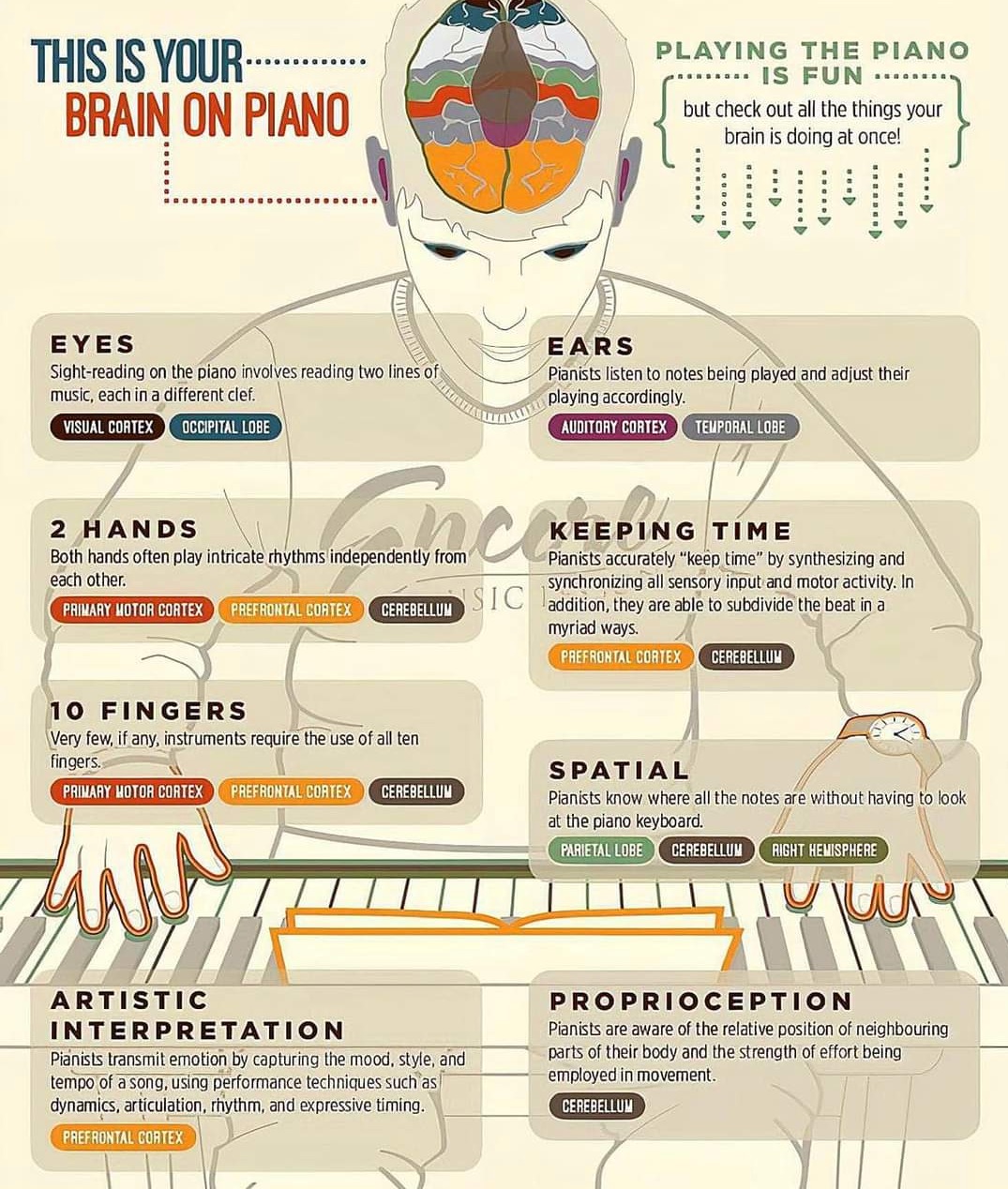
Every time we practise, we are not just moving our fingers, we are literally sculpting our brain. This phenomenon is called neuroplasticity, the nervous system’s ability to modify its own structure in response to experience. Playing the piano is an immensely powerful activity that simultaneously activates between 20 and 30 neural networks, more than language uses. It is no coincidence that professional pianists show an increase in grey matter volume and a more developed corpus callosum.
However, this process of neural sculpting needs time to consolidate. And here an often-neglected ally comes into play: rest. Contrary to what one might think, improvement does not only occur during active practice, but especially during breaks and, crucially, during sleep.
The brain takes between 6 and 24 hours to consolidate a new motor skill. During sleep, the neural connections created during practice are strengthened and transferred into long-term memory. A study by Simmons and Duke even documented an incredible 60% improvement in performance after a full night’s sleep.
The lesson is clear and counterintuitive: sacrificing sleep to practice more is a counterproductive strategy. Rest is not a break from practice; it is an integral and productive part of the practice itself.
A Bespoke Stopwatch: How Much to Practice Based on Age and Goals
If quality is the “how”, quantity – the “how much” – depends entirely on the “who”. There is no universal number of hours, but guidelines based on age, level and ambitions.
Children (5-12 years): The key is the frequency of short sessions. For the very young (5-8 years), 15-20 minutes a day is ideal. The Suzuki Method even suggests micro-sessions of 2-5 minutes, repeated several times a day. As they grow (9-12 years), one can progress to 30-45 minutes daily.
Teenagers (13-18 years): The repertoire becomes more complex. For those playing for pleasure, an hour a day is a solid base. For students at specialist music schools or those aspiring to enter a conservatoire, the commitment rises to 1.5-3 hours daily, with peaks of 4-5 hours before exams or competitions.
Adult amateurs: Consistency is everything. Even just 20-30 minutes of daily, regular practice leads to enormous progress and acts as a powerful anti-stress tool. For those with more serious ambitions, the threshold for tangible progress is often around 90 minutes a day.
Conservatoire students and professionals: Here practice becomes a full-time job. Official curricula, like that of the Trieste Conservatoire, schedule hundreds of annual hours, which translates to an average of 3-6 hours of individual practice per day.
Lessons from the Giants: Between Discipline and Instinct
The routines of the great masters do not offer a magic formula, but a lesson in personal coherence and an intelligent approach to work. Their habits, sometimes opposite, demonstrate that there is no single path to excellence.
Frédéric Chopin: The “Intelligent” Study
Chopin was a convinced advocate of moderation. He forbade a pupil from exceeding three hours of practice a day, defining excessive work as “mechanical, unintelligent and useless.” He recommended short, concentrated sessions, interspersed with restorative breaks to rediscover inspiration. He detested the purely technical exercises fashionable in his time, like those of Czerny or Hanon, believing that true ability derived from solving difficulties within the musical context. His advice was: “always practice Bach – it will be your best means of progress.” He himself studied “The Well-Tempered Clavier” daily. His approach was also innovative in physiology: he taught scales starting with those with more black keys (like B major), more suited to the hand’s natural conformation than the “most difficult” C major scale. For Chopin, technique was a means, not an end, to free musical expression.
Arthur Rubinstein: Life as Practice
Rubinstein had an almost hedonistic relationship with practice. “Never practice more than three or four hours a day,” he advised. “The rest of the time must be spent learning about life, love, art.” He believed that excess practice killed spontaneity, depriving music of that “drop of fresh blood” necessary to move an audience. However, this philosophy was not always his guide. In the 1930s, realizing technical gaps, he withdrew for months, dedicating himself to intensive practice of 6-9 hours a day, rediscovering new meanings in the music. Having overcome that crisis, he returned to his creed: music is nourished by experiences. He preferred to practice the repertoire directly, constantly reviewing pieces to keep them alive, rather than isolating technique. His practice was guided by the passion and inspiration of the moment, not by a rigid routine.
Vladimir Horowitz: Creative Rigour
Horowitz’s discipline was a mix of rigor and originality. While dedicating about four hours a day to practice during intense periods, he categorically rejected traditional exercises. “They are bad for the ear and the touch, because they have no life,” he stated. In their place, he invented his own “calisthenics exercises” every day, a series of slow and creative movements to warm up his hands. He was famous for his meticulous practice: he would work on a section, or even on a few bars, until he achieved the desired sonic perfection. Mental practice was also crucial: he could analyze and “feel” a piece in his head before even playing it. He also followed the advice of his mentor Rachmaninoff: “If you don’t walk… your fingers won’t run.” Every day, after practice, he took long walks, convinced that physical well-being and mental detachment were essential to playing at one’s best.
Martha Argerich:The Genius of Instinct
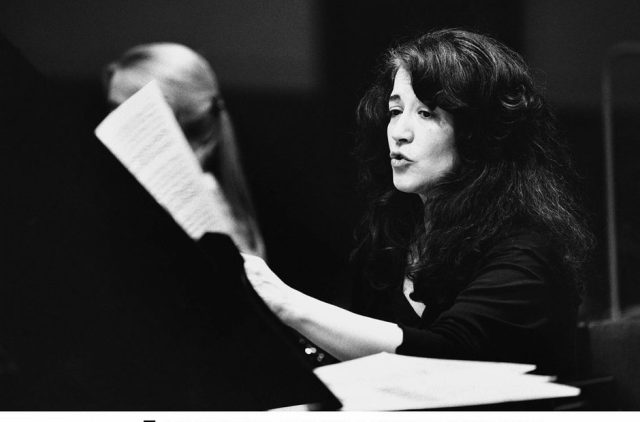
Argerich is the nonconformist par excellence. Her prodigious technique is not the fruit of daily routines. “Scales? Never done them. Exercises? Never… I have always practiced through pieces. If something wasn’t right, then I worked on that specific passage.” She solves difficulties “on the field”, immersed in the musical context. She has no fixed schedule and, being a “nocturnal animal”, prefers to practice until the first light of dawn. She detests the solitude of the recital and finds her greatest motivation in ensemble music, rehearsing with other musicians. Her routine is not having a routine. “I don’t like the thought of practising, but when I start doing it, then I like it,” she admitted. In this paradox lies her genius: a pianist who escapes rules, achieving astonishing results thanks to a total and instinctive immersion in music, when inspiration calls.
A famous aphorism also circulates in the musical world: “If I miss one day of practice, I notice; if I miss two, the critics notice; if I miss three, the audience notices.” Although popular culture often attributes it to Paganini, rigorous source research, such as that conducted by the site Quote Investigator, reveals that its true authorship is uncertain. The uncertainty, however, does not diminish its value; on the contrary, it underlines its universality as a manifesto for consistency.
Sustainable Balance: Preventing Injury and Burnout
Playing the piano is an athletic activity. Ignoring the health of the body and mind is the quickest way to interrupt one’s journey. About 50% of pianists seek medical assistance for injuries like tendonitis or carpal tunnel syndrome.
Prevention is fundamental:
- Correct and dynamic posture.
- Warm-up and cool-down.
- Take regular breaks (e.g., 5 minutes every 30 minutes of practice) to prevent the accumulation of microtraumas.
- Listen to your body: pain is not a sign of weakness, but a signal never to ignore.
In the same way, mental health is crucial. You must set realistic goals, celebrate small progress, avoid demotivating comparisons on social media and, above all, maintain a healthy balance between practice and the rest of life.
The Answer Lies Within You
In the end, the answer to the question “how much should I practice?” is not a number, but a philosophy. The pillars are four:
- 1. Consistency: Regularity always beats duration.
- 2. Quality: Deliberate practice transforms time into ability.
- 3. Method: A practice architecture prevents stagnation.
- 4. Sustainability: The health of body and mind are prerequisites, not an optional extra.
The final invitation is to become scientists of your own learning process. Keep a diary, monitor what works, be honest about your energy levels and adapt your routine. The answer is not in the habits of the keyboard giants, but in your ability to listen to yourself.
By finding your personal balance between discipline and joy, between effort and recovery, you will build a unique, effective and, above all, lifelong path capable of nurturing not only your skill, but also your love for music.
Article by: Giulio Cinelli – 22 July 2025
 Pianosolo.it is a project in favor of thousands of Italian speaking people with a common passion: the piano. Online since 2008, pianosolo.it was the first Italian blog completely dedicated to this theme. It offers daily news, lessons with video tutorials, interviews, reviews, in-depth articles, reports and opinions on piano world news, pursuing the aim of a widespread dissemination of musical culture at all levels.
Stay in Tune with the Piano World
Join over 70,000 piano enthusiasts and get our exclusive monthly newsletter filled with classical piano news, inspiring articles, sheet music and other resources.
It’s FREE to join, and you can unsubscribe at any time.
Comments
Consistency beats volume every time — 30 focused minutes daily will take you further than a 3-hour weekend grind. The science supports it, but honestly so does lived experience at the piano. And when the passion is genuine, the hours stop feeling like a metric anyway. You just play.