Manu Sinistra, Harmonies of Hope – Interview with Illia Ovcharenko
The young Ukrainian star pianist Illia Ovcharenko is making waves with Manu Sinistra, a new album featuring three left-hand concertos by Maurice Ravel, Sergei Prokofiev, and his compatriot Sergei Bortkiewicz — a true discovery. Eric Schoones met the passionate artist for a conversation.
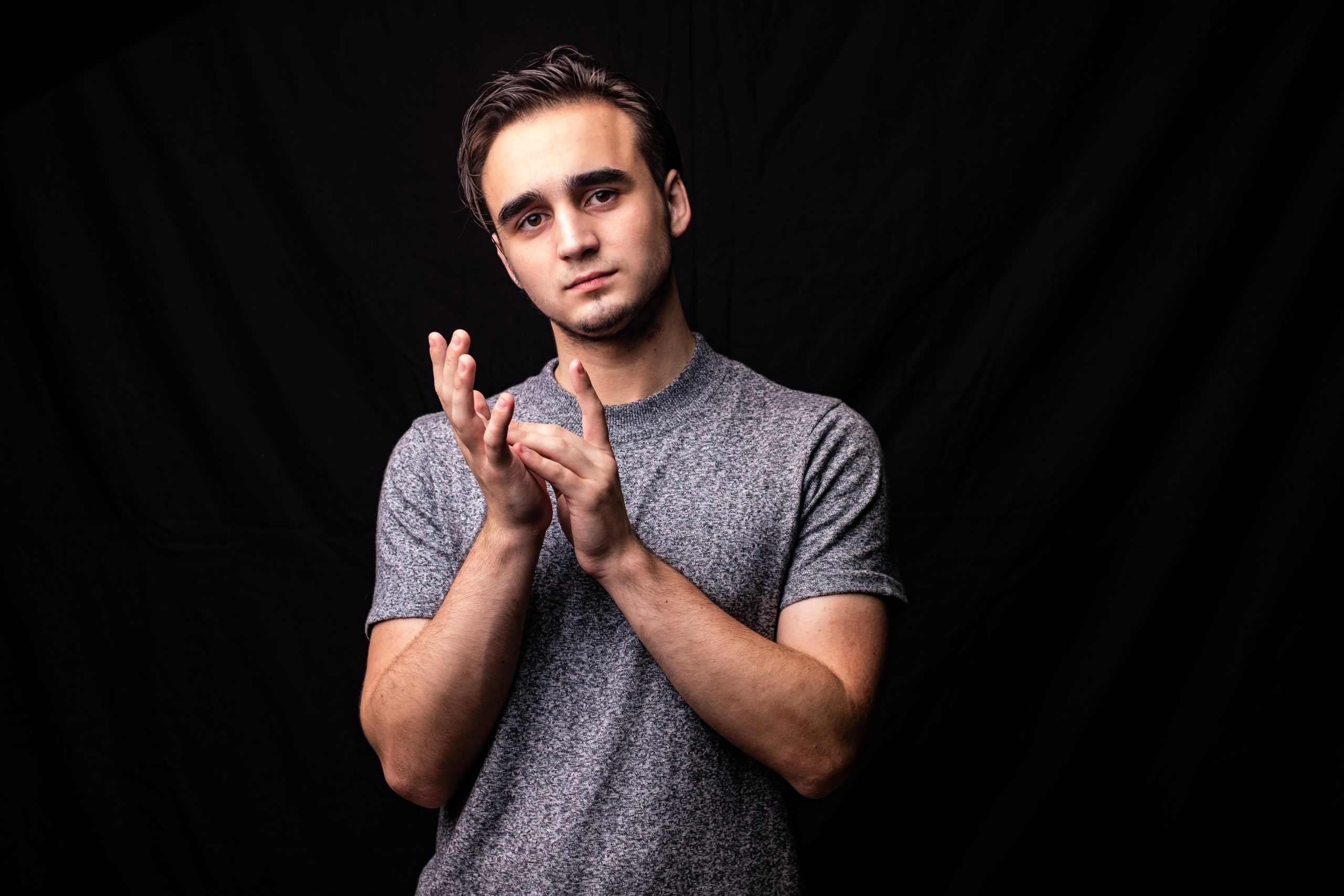
With this new release, Ovcharenko once again confirms his exceptional status. Soon he will perform at the Konzerthaus in Berlin and the Concertgebouw in Amsterdam playing the First Piano Concerto by Johannes Brahms together with the Youth Symphony Orchestra of Ukraine and conductor Oksana Lyniv, who also conducted the CD recording.
Eric Schoones: Your sound and your approach to music remind me of Vadym Kholodenko.
Illia Ovcharenko:
(He reacts with pleasantly surprised delight.)
Oh, thank you — that’s a great privilege. We’re actually good friends, and next year we’ll be performing together.
ES: Wonderful, your album seems a powerful statement. In your liner notes you mention ‘a dialogue across a century, a collection of musical echoes born from resilience.’
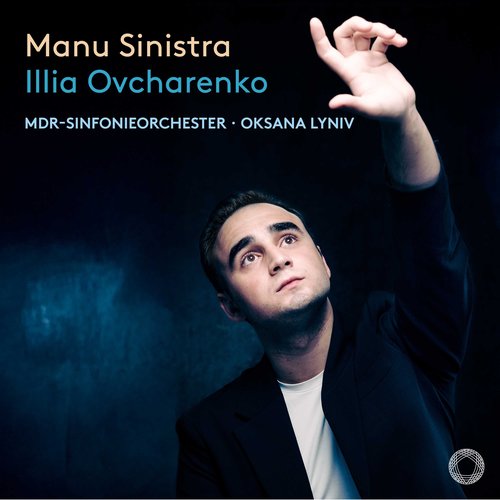 IO: Well, the hundred-year connection is partly coincidental, but the message is certainly intense, with the war a century ago and the war today. And of course Paul Wittgenstein is such an inspiration. He commissioned the concertos by Maurice Ravel, Sergei Prokofiev and Sergei Bortkiewicz that are featured on the CD, and that story simply stayed with me — I felt I had to do this project. Imagine: after losing his right arm, he refused to stop playing. That’s extraordinary.
And not many people realise how rich Ukrainian culture is. We have so many wonderful composers, and I feel it is my mission to make them better known. Once you truly get to know the music, you realise that Bortkiewicz stands on the same level as Ravel and Prokofiev. At first his concerto seems almost impossible to play, but with time, and with the right musical decisions, everything becomes possible. Then you begin to understand the genius of the writing. In fact, I would compare his style to Sergei Rachmaninoff.
ES: You said Bortkiewicz expressed the tragedy of war in a most profound way.
IO: Yes. His life itself was tragic. He lived in different countries simply because he was constantly pushed across borders by the violent tides of the 20th century. The concerto was written in 1922, right after the First World War. Yet amid all the darkness there are these lyrical, poetic moments of hope. The music feels pure and deeply human. You sense that despite all the misery he was still able to find happiness in music and hope for the future.
ES: That is actually the power of music in a nutshell, isn’t it?
IO: Yes, it’s like in Franz Schubert — suddenly, through the harmonies, you feel hope.
ES: I remember Alfred Brendel telling me Schubert expressed moments of consolation best in the minor keys.
IO: Exactly!
ES: You will be touring soon with the Youth Symphony Orchestra of Ukraine and Oksana Lyniv.
IO: It will actually be my first time with them, although I’ve worked many times with Oksana. We share the same musical language, and it’s always a great pleasure to collaborate with her. She has been an inspiration to me since I was very young. She is one of the most prominent Ukrainian musicians and has always championed Ukrainian culture. She founded the wonderful Youth Symphony Orchestra of Ukraine and many friends of mine at school who played in it were always talking about the importance of the orchestra and being able to perform under Oksana’s direction. So for me, this tour is truly a dream come true. We also made the recording together with the MDR Symphony Orchestra Leipzig. You know, it’s not easy for an orchestra to record three concertos, two of which are completely outside the standard repertoire. But they were wonderful — incredibly prepared, focused, simply playing beautifully and exchanging ideas. I really felt supported.
ES: On this tour you will be performing Piano Concerto No. 1 by Johannes Brahms.
IO: That will also be a first for me. I’ve always wanted to play both Brahms concertos, and I’m especially looking forward to performing in great halls in Amsterdam and Berlin.
ES: You were very careful not to overstress your left hand, whereas pianists tend to have those problems with the right hand.
IO: Perhaps I worried too much about practising only with the left hand for weeks, but in the end it wasn’t really a problem. There’s actually less risk of overdoing it than people think, because with the left hand you often bring out the melody with the thumb — your strongest finger — whereas with the right hand that role frequently falls to the little finger. As Horowitz said, you need strong pinkies to play the piano. What also helped was sitting slightly more to the right instead of at the centre the keyboard, giving the left hand more freedom. I even used my left foot for the sustain pedal at times. But actually it’s quite amazing how beautifully and naturally one can shape the melody with the thumb of the left hand.
ES: Your father is an athlete and sports coach, and your great hero is Roger Federer — perhaps not what one immediately expects from a classical pianist.
IO: Well, growing up I did a great deal of sport — gymnastics professionally, table tennis, basketball, you name it. I loved all of it, and sports taught me discipline, endurance and hard work. But in the end, that kind of athletic life doesn’t combine very well with piano playing, and my love for music was stronger. There was also a psychological aspect. On stage I don’t usually feel so nervous, and especially in competitions my experience in sports helped me focus purely on the music and on doing my best. Much of my confidence — which is so important for a musician — came from my mother and from the belief my parents always had in me. I’m deeply grateful for their support.
ES: You were particularly successful at the Honens International Piano Competition – you got the first prize in 2022 – where the idea of the complete artist is so important.
IO: That was actually one of the main reasons I applied. I felt the competition had something unique. They are interested not only in the musician, but also in the person behind the musician. Through interviews they try to discover who you are as a human being. I think that’s incredibly important.
And the format itself — chamber music, accompanying singers, solo repertoire, concertos with orchestra — it really tests the full range of skills a modern musician should have. It’s a complete artistic portrait. A pianist may be tremendously gifted, but here every aspect is taken into account, even the interviews. I found the whole concept of the complete artist fascinating, and I had wanted to apply for years. As soon as I reached the required age, I did.
ES: One could perhaps say your lessons with Arie Vardi prepared you for that?
IO: I was seventeen when I entered his class, and he truly opened up a new intellectual understanding of music for me. At that age you are naturally changing all the time, but he helped me in the best possible way to find my own path and to explore my inner musical world more and more deeply.
ES: You once said: ‘In concert, two souls — the composer’s and your own — are united.’ Beautifully put.
IO: Thank you. You study the score and respect the composer absolutely, but in the end there is no single definitive answer to what the composer wanted. What we can do is respect the composer as deeply as possible while still giving the music our own voice and interpretation. I believe this music was written for all of us to interpret differently, because we all live different lives and carry different histories within us. That, to me, is also the beauty of music: it belongs to everyone.
ES: You may know what your fellow Ukrainian pianist Alexander Gavrylyuk once said: ‘Not many things in this world can unite people — no form of diplomacy could ever do that. I think music comes closest, because it reveals that perhaps, on a deeper level, we are all quite similar. When the audience reacts in one wave of emotion that to me is the most incredible and inspiring thing’.
IO: Yes, I truly believe that as well. Audience members have sometimes told me they came to a concert after something terrible had happened in their lives, simply hoping to forget about it for a while. And if, through music, you can help someone forget their pain even for a single moment, I think that is the greatest compliment a musician can receive. Our task is also to help people carry their traumas, and to connect them with something eternal: music.
Text: Eric Schoones
Illia Ovcharenko’s upcoming performances:
July 26 Amsterdam, Concertgebouw
August 1 Berlin Konzerthaus
The tour also includes collaborations with the National Youth Symphony Orchestra of the Netherlands.
This article is a contribution from the German and Dutch magazine Pianist through Piano Street’s International Media Exchange Initiative and the Cremona Media Lounge.
 Pianist Magazin is published in seven countries, in two different editions: in German (for Germany, Austria, Switzerland, Luxembourg and Liechtenstein) and in Dutch (for the Netherlands and Belgium).
The magazine is for the amateur and professional alike, and offers a wide range of topics connected to the piano, with interviews, articles on piano manufacturers, music, technique, competitions, sheet music, CDs, books, news on festivals, competitions, etc.
For a preview please check: pianist-magazin.de or www.pianistmagazine.nl
Stay in Tune with the Piano World
Join over 70,000 piano enthusiasts and get our exclusive monthly newsletter filled with classical piano news, inspiring articles, sheet music and other resources.
It’s FREE to join, and you can unsubscribe at any time.
Comments