Wood, Wire, and Fire: The Architects of the Piano’s Soul
For three centuries, we have mythologized the virtuosos and idolized the composers. In a wide-ranging new chronicle, Jeremy Nicholas turns the spotlight on the eccentric inventors, cabinet-makers, and resilient visionaries who built the instruments behind the music.
Consider the concert grand. It sits on the world’s great stages like a sleeping leviathan – a marvel of engineering comprising ten thousand moving parts, tensioned by twenty tons of iron and high-carbon steel, concealed beneath a sleek armor of polished ebony. When the pianist strikes the keys, the machine breathes. It is at once a solo voice, a devoted accompanist, and a composer’s ultimate canvas.
– George Bernard Shaw
For centuries, the story of this instrument has been told almost exclusively through the hands of the performers who tamed it and the minds of the composers who demanded more from it. The makers — the men who stretched the wire, cut the felt, and imagined the impossible — were left largely in the shadows.
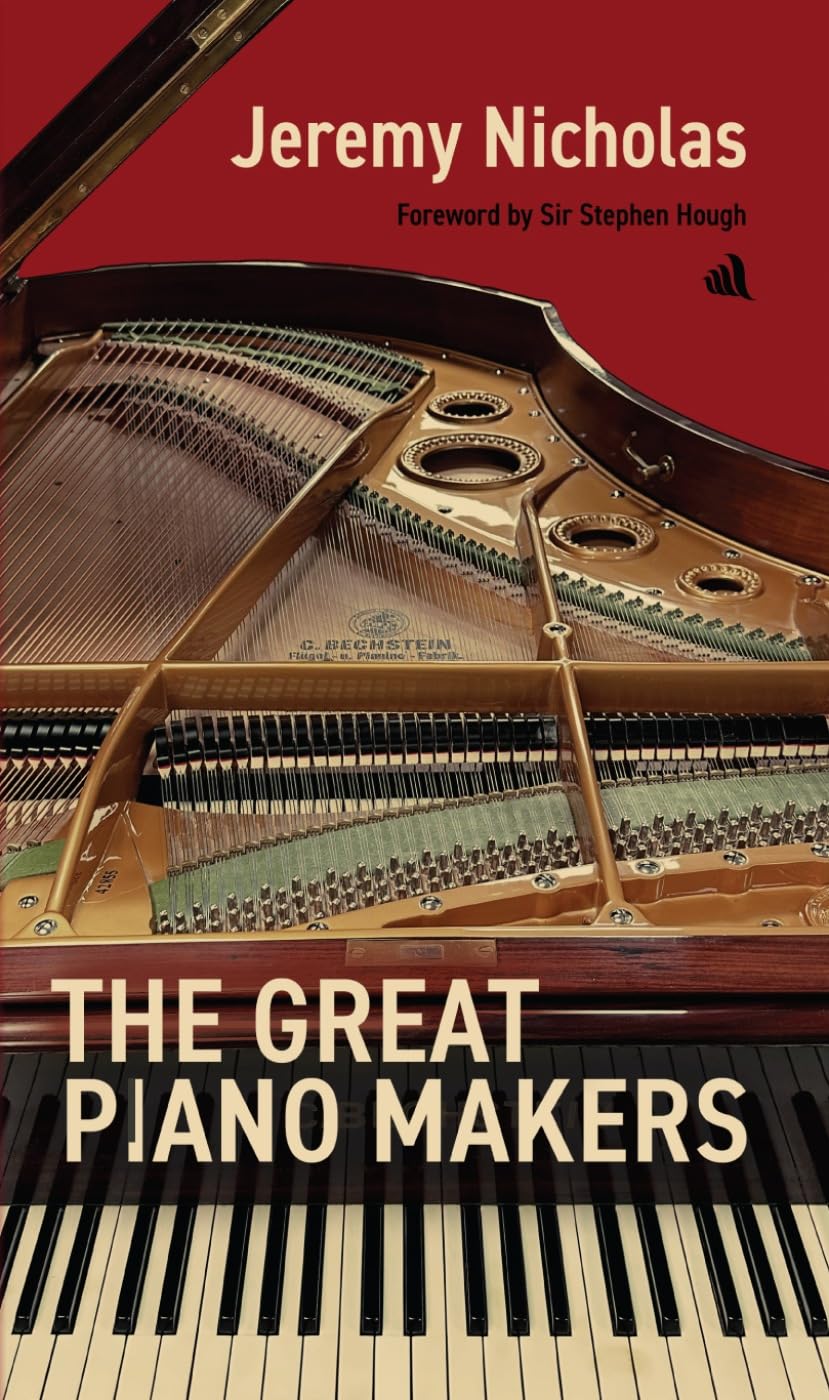
Now, in his new book, The Great Piano Makers, acclaimed music writer Jeremy Nicholas restores the balance. Charting three centuries of staggering innovation, devastating factory fires, and fierce ambition, Nicholas reveals a profound irony: the architects of our highest musical culture were rarely musicians at all, but tradesmen, tinkerers and entrepreneurs.
Piano Street’s Patrick Jovell sat down with Nicholas to discuss his book, the catastrophic birth of the modern concert grand, and the enduring humanity locked inside the ultimate musical machine.
Into the Workshop
Patrick Jovell: Dear Jeremy, thank you for your wonderful and inspiring book! We all know you as an appreciated writer on music and musicians. What prompted you to shift the focus from performers and composers to the instrument’s makers?
Jeremy Nicholas: I don’t think it’s a shift in focus so much as a complementary subject, but it is certainly one that is addressed less frequently than the subjects of performers and composers. The genesis of the book is very simple to explain. I have been writing for the UK magazine International Piano (or International Piano Quarterly as it was) since 1996 when it was founded, and I have contributed to every issue since, be it quarterly or monthly.
In 2006, the then-editor Julian Haylock rang to ask if I would be interested in writing an article for the magazine on the Bösendorfer company. I demurred as I knew virtually nothing about piano manufacturing—and in fact had only ever been to one piano factory in my life, Steinway in Hamburg, on a press visit a few years earlier. Anyway, I wrote the Bösendorfer piece, the editor liked it and, thanks to Julian, it turned into a series. Over the next few years and a few other editors, I wrote about 40 articles on different piano makers because it was a subject with which I had become completely fascinated.
What interested me more than the actual mechanical developments of the piano (though these were interesting enough) was the story of the people behind the businesses. Who exactly was Mr. Bösendorfer? How did Mr. Steinway begin making pianos? How did Mr. Yamaha get started? The most surprising thing to emerge was that most of these pioneers were not musicians at all, but cabinet makers and furniture makers, or often simply inventors. There were very few men—and they were almost all men who founded these businesses—who were pianists as well as piano makers, the obvious exceptions being Clementi, Cramer, and Henri Herz.
That was how most of the material in the book was written, though since the series in the magazine ended over a decade ago, I expanded, updated, and revised every single one of the original essays. The book was never intended to be a history of the development of the piano, yet that is one of the unconscious byproducts of the book. Neither did it aim to chart the associations between composers and pianists and their demands on various makers. Nevertheless, that again is inevitably part of the story.
One surprising element, amusing in a way but in fact rather serious, was the number of piano companies that caught fire in the 19th century. Some were saved, others burnt to the ground—cigarettes and pipes not being ideal bedfellows at that time. One senses that just a few of them might have been insurance claims…
A Machine of 10,000 Parts
PJ: You describe the piano as at once a machine and a cultural symbol. How important is that duality to understanding its place in musical life?
 JN: It’s an interesting dichotomy—or is it an anomaly?—that a machine should be such an important symbol of cultural life. One never thinks of a clarinet or French horn as a machine. They are viewed as purely musical instruments. I don’t say the piano is, in general terms, viewed differently except that it is a mechanical device, a machine consisting of 10,000 moving parts—unlike a clarinet and French horn. But the piano occupies, more than any other instrument, a unique position in our cultural life, bridging the worlds of art, education, and domestic experience. There’s no other instrument that has achieved such versatility, nor one that provides the means of expression for both professional and amateur music making, anywhere from the concert halls of the world to the family home.
The piano has played a crucial role in the development of Western music and, after all, has been the primary instrument used by composers to experiment, compose, and perform their works, whether it be classical sonatas, jazz improvisations, or contemporary pop songs. Is there another instrument that has appeared so frequently in literature, film, and art?
There are far fewer piano manufacturers in the world today than there were in the 19th century. For instance, there were over 700 in London alone, whereas now there are none. But the number of pianos being produced is probably as great as it has ever been. There are reportedly 42 million people in China who are learning the piano. And though the cost of an acoustic upright, let alone a grand piano, is beyond the means of many, digital keyboards offer a cheaper alternative and have given thousands access to domestic music making that they would not otherwise have been able to afford. I have to say though, regarding my book, that it does not cover digital keyboard manufacturers. That seemed to me to be a whole new subject that needed another book!
Visionaries, Fire and Fortune
PJ: Composers such as Beethoven and Liszt famously stretched the limits of their instruments. Do performers still exert that kind of influence on piano design today?
JN: Yes, but not in the same dramatic way that they once did, say in the days of Beethoven and Liszt, who would push piano makers to expand the instrument’s potential—greater volume, stronger frames, and more responsive action—because their music demanded it. It was the mid-19th century that saw major structural developments. After that, you have artists like Busoni asking Bösendorfer for some extra bass notes to accommodate the music he was writing.
In recent years, I suppose the best-known example of an artist influencing piano design was in 2011 when Daniel Barenboim had the opportunity to play Liszt’s recently restored Bechstein. As I say in the book, so impressed was he by the sound and discovering that the piano was straight-strung, he became interested in creating a similar instrument. He then got in touch with a Belgian maker called Chris Maene, and in 2015 launched the Barenboim-Maene Concert Grand, the first instrument to bring back the straight-strung concept to the 21st century.
PJ: Your chapter on “eccentrics and visionaries” introduces figures such as John Joseph Merlin. How significant were these more unconventional contributors?
JN: I think they were immensely important during the development stage of the piano in the first half of the 19th century. These eccentric inventors like Jean-Henri Pape and John Joseph Merlin came up with many ingenious devices, some of which worked, some of which were quickly forgotten. But whether successful or failures, these kinds of people are essential to the development of any new invention—cars, aeroplanes, computers, whatever—providing solutions or suggestions or ideas. Many of these inventors ended up broke. Pape, for instance, died a poor man. He became obsessed with building pianos in all kinds of impossible shapes—round, elliptical, hexagonal—none of which ever caught on. In addition, one might note that Carl Bechstein worked with Pape for a year before opening his own firm. So there was one eccentric and visionary who had a major influence on one of the most important and successful piano makers.
PJ: The year 1853 saw the founding of Steinway & Sons, Bechstein, and Blüthner. Why does that moment stand out in the instrument’s history?
JN: In terms of the piano’s history, 1853 is known as the annus mirabilis because it saw the founding of three of the most famous and, as it has turned out, enduring makes of piano manufacturers: Blüthner of Leipzig, Steinway & Sons of New York, and Carl Bechstein of Berlin. It was significant because after the leading French makers Gaveau, Erard, and Pleyel had lost their dominance in Europe, most major artists then transferred their allegiances to either Bösendorfer or one of the three manufacturers all founded in that same year.
PJ: Many firms experienced both success and sudden decline. Were there particular stories of resilience that you found especially striking?
JN: There are two stories that stand out and make one aware of how courageous and enterprising you have to be to make a success of your piano-making business. Clementi founded his piano firm in the 1790s and was so successful that he decided his physical presence was no longer required for its day-to-day running, setting off in 1802 for a trip around Europe. He did not return for eight years. On the 20th of March 1807, the company suffered the first of two major fires in its history. Its piano factory in London was burnt to the ground. The workshop, storerooms, and finished instruments were all lost to a total value of £40,000. Only £15,000 had been covered by insurance. Other proprietors would have rushed back to take command of the situation after such a calamity. Not Clementi. The music publishing side of the business was flourishing and this, combined with the new factory and the business acumen of the Collard brothers (who were by then in partnership with him), allowed the piano manufacturing to return with even higher profits. Clementi didn’t come back to England until 1810.
The other story of resilience I like is the Czech manufacturer Petrof, founded in 1864—a most successful company until the Communists took over in 1948 when the firm’s owners were deprived of their rights. After three generations of ownership, the Petrof family was forced to leave the factory. Jan Petrof, the great-grandson of the founder, was forced to work in a woodworking factory. Eventually, after the fall of Communism, Petrof instigated a claim against the government for trading under his name without any recompense. Negotiations went on for a full decade while a formula was agreed upon, valuing how much of the company’s asset base belonged to the Petrof family and how much was the lawful property of the state. Eventually, the family was able to purchase back their interest in the company, and it thrives today under the leadership of Jan Petrof’s granddaughter.
A Shifting Global Landscape
PJ: The shift from European dominance to companies such as Yamaha and Kawai marks a significant change. How has this altered the global piano landscape?
JN: After a century and more of European dominance, Asian companies dominate today in terms of volume and mass production. Most pianos are now built in Japan, China, and South Korea. China’s Guangzhou Pearl River Piano Group is the largest piano producer by volume in the world. The Asia-Pacific area combines scale, lower costs, and growing technical sophistication (particularly Yamaha and Kawai). The reasons for this change are many, but are mainly due to lower production costs compared to Europe and greater domestic demand, especially in China and Japan. There is also, most importantly, a strong emphasis on music education in China and among the Asian middle classes.
However, Asian companies do not completely dominate the high-end prestige end of the market. Brands like Steinway, Bechstein, and Fazioli still retain much higher reputations for craftsmanship and exclusivity. They also still dominate concert halls and the luxury end of the market.
PJ: In an age of digital technology, makers such as Fazioli continue to refine the acoustic instrument. What, in your view, ensures the piano’s continued relevance?
JN: To answer this, I have to turn to the last section of my book—Envoi—in which I say that the inventors, engineers, musicians, and entrepreneurs who appear in its pages have combined to give us an instrument that has given countless thousands of men, women, and children a means of expression that has brought indescribable joy to their lives. It has provided a living for many thousands of professional pianists whose artistry has thereby given untold millions of people some of the most uplifting, rewarding, spiritual, and entertaining hours they have ever experienced. It has also given solace to the lonely and bereaved—and provided for us pianists, whether amateur or professional, an endless, fruitless, unattainable search for perfection. The piano endures. Acoustic, hybrid, or digital, it is not going anywhere soon.
Stay in Tune with the Piano World
Join over 70,000 piano enthusiasts and get our exclusive monthly newsletter filled with classical piano news, inspiring articles, sheet music and other resources.
It’s FREE to join, and you can unsubscribe at any time.
Comments
Mostly self taught until late in life, my technique and virtuosity is limited, nevertheless, I have always marveled at the piano’s construction and subtleties of touch and sound from different pianos. I tried many in a store that happed to carry most of the finest pianos in the world as well as some lessor brands. The top pianos were all wonderful. I recognized the difference in response due to the quality of the action, the tone, a function of several elements, and overall quality. Also, it should be noted that even the finest instruments can be unplesant to play and hear if not properly regulated and tuned. I eventually purchased a Mason & Hamlin BB and also have a full upright Petrof in my study. Despite rigid manufacturing specifications, each piano seems to have a personality of it’s own. I love the feel and touch of a fine piano and the craftmanship in all of its details. No electronic keyboard is as satisfying as touch, response, overtones and vibrations of a fine piano.